dsh-gongwen-word-check
Verifieddsh-gongwen-word-check · v0.2.4 · Apache-2.0
公文格式要素核对(按公开的党政机关公文格式标准核对版头与主体要素,仅提示差异,不作出定性结论)
Install
dsh plugin add dsh-gongwen-word-check Confirm the layer applied with dsh --profile default --dump-config — see the install guide.
Source
Tags
Readme
dsh-gongwen-word-check — Document register formatting-element check for official documents

dsh-gongwen-word-check reads one document register — one row per issued document — and checks the text that register records against a versioned rule pack: whether 发文字号 follows the 「机关代字〔年份〕序号」 shape with the year in 六角括号〔〕, whether 成文日期 parses as a date and is not later than the day of the check, whether 文种 comes from the vocabulary your own unit configures, whether 主送机关 is filled in, whether 标题 stays within the configured length, whether a 发文字号 repeats anywhere in the register, and whether a title still holds an unreplaced template placeholder.
What it looks like
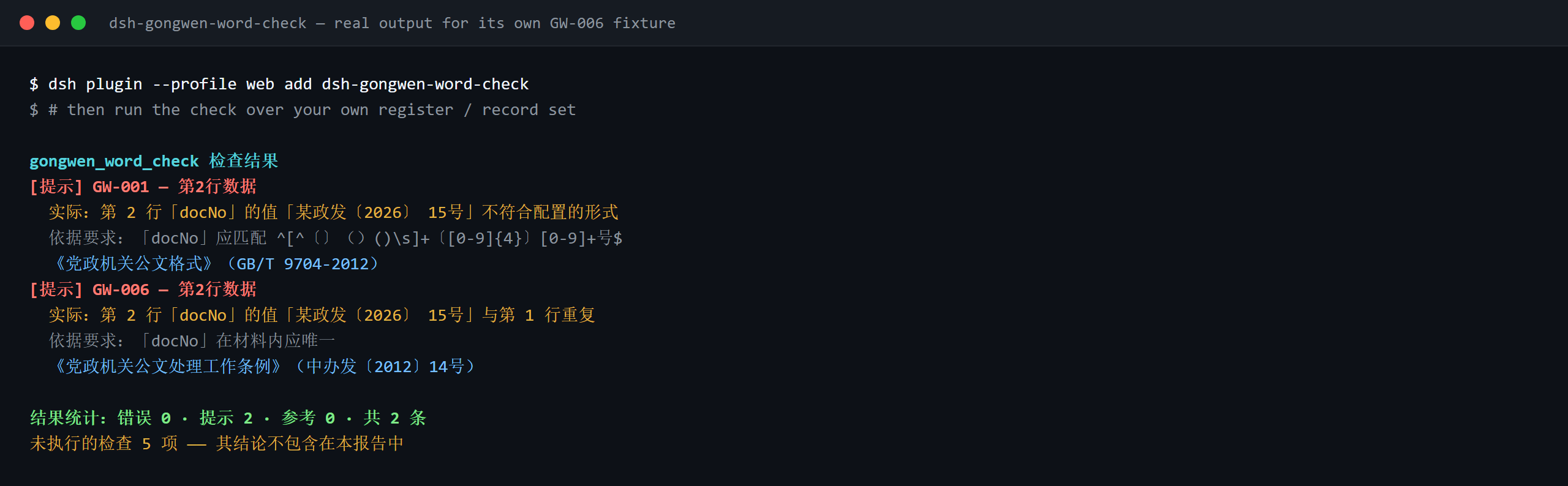
Real output from this plugin over its own GW-006 test fixture — not a mock-up. The rule pack ships no invented quotations, so a finding names both the clause it applied and the fact that the clause text was not obtained.
What it answers
| You ask | What it answers |
|---|---|
The document number was typed as 某政发[2026]15号, with square brackets. |
GW-001 reports the row: the pattern it was configured with requires 六角括号〔〕 around the year, so 某政发〔2026〕15号 is the shape to write. The rule only checks the document number's form — the 机关代字 itself is set by your unit, so it does not judge whether the code is the right one, nor whether the serial numbers are consecutive or reused. |
| The signing date is written the way a document usually carries it: 二〇二六年三月十五日. | GW-002 reports that it cannot parse this value. It reads 2026-03-15 and 2026-03-15 09:30; a 汉字 date has to be written in one of those forms, or the rule switched off. The rule also does not check the signing date against the dispatch date — that is internal to the issuing workflow. |
We never configured the list of 文种 for our unit. Does GW-003 quietly pass? |
No. GW-003 carries no built-in list, so with values unset it appears in the report's skipped rather than passing silently. 《党政机关公文处理工作条例》 lists fifteen main kinds, but the pack does not hard-code them — which kinds your unit may use is your own decision. The rule also does not judge which kind a given document ought to have used. |
| A row leaves 主送机关 blank. | GW-004 reports that row, because without a main recipient there is nothing to confirm who the document was sent to. It checks that the column is filled in, not whether the recipient range is the right one — who is addressed and who is copied is a drafting decision. |
| Our title is long. Where does the length limit come from? | GW-005 reports a 标题 longer than the configured ceiling of 60 characters. That figure is this rule pack's default, not a standard number: GB/T 9704-2012 fixes 「2 号小标宋体字」 for the title and gives no character limit, so if your unit writes longer titles, raise maxLength or switch the rule off. The rule only counts characters — it does not judge the wording of the title. |
| Two rows carry the same 发文字号. | GW-006 reports the repeated number; it compares values ignoring whitespace, and a hit usually means a reused or mistyped number that a human has to confirm. It does not decide which of the two documents should hold that number. |
Standards it follows
| Document | Number | Cited by rules |
|---|---|---|
| 《党政机关公文格式》 | GB/T 9704-2012(现行,本次未取得条文) | GW-001, GW-002, GW-004, GW-005, GW-007 |
| 《党政机关公文处理工作条例》 | 中办发〔2012〕14号(自 2012 年 7 月 1 日起施行) | GW-003, GW-006 |
Boundary: this plugin checks a 公文台账的版头与主体要素 for what a register can be held to mechanically — that the document number follows its 「机关代字〔年份〕序号」 shape, that the signing date parses, that the document kind comes from your vocabulary, that a main recipient is recorded, that the title is not over-long, that numbers do not repeat, and that no template placeholder survives. It checks the text a register records, not the layout — typeface, size, margins and seal placement can only be judged from the document itself.
⚠️ What the citations in this plugin's report actually rest on
《党政机关公文处理工作条例》(中办发〔2012〕14号) was obtained and read verbatim, and
rules/evidence/clause-verification.mdrecords which articles were quoted — article 8 (the fifteen document kinds), article 9 (the format elements, including 「发文字号。由发文机关代字、年份、发文顺序号组成」 and 「主送机关。公文的主要受理机关」), article 10 (which delegates layout to GB/T 9704-2012) and article 42 (in force from 2012-07-01, superseding two earlier documents this pack therefore never cites).GB/T 9704-2012 itself was not obtained. That matters for one detail worth stating plainly: the 六角括号〔〕 in
GW-001's pattern is the layout standard's convention, not something the regulation fixes — article 9(5) requires only 「发文机关代字、年份、发文顺序号」.The rule
excerptfields still say "本次未取得", and every rule remainswarnorinfo. What this plugin checks is what a register of text says; the regulation governs the document, so calling a blank column adirectbreach of "a document shall consist of …" would overstate the finding. Half the rules rest on the layout standard or on your own convention in any case.Two thresholds are local, and the pack says so. The title-length ceiling (
GW-005, 60 characters) is this rule pack's default, not a standard figure — article 9(7) fixes only that the title consists of the issuing body, the subject and the kind, and no character count appears in either document. And the document-kind vocabulary (GW-003) ships empty despite article 8 listing fifteen kinds, because the article says "主要有" and units also use names outside the list.The placeholder check deliberately omits 「某」 from its term list: template titles often read "关于某某工作的通知", but 某 also appears in legitimate titles as a stand-in for a confidential subject.
Compatibility
| Surface | Status |
|---|---|
| Harness | Peer range >=0.1.2-rc.1 <0.2.0 || >=0.2.0-0 <0.3.0 — verified to accept both 0.2.0-rc.2 and 0.2.1-alpha.1. engines.dsh is deliberately not declared: it has no reader and cannot reject a host |
| Node | `^22.19.0 |
| Platforms | All (plain ESM; no native code, no network, no model call) |
| Tool mode | Works in native, ptc and both; for a year's register use ptc |
What it does
Registers the gongwen_word_check tool. It reads one document register — one row per issued document — applies
a versioned rule pack, and returns a report.
| Rule | Check | Severity | Basis kind |
|---|---|---|---|
GW-001 |
the document number follows 「代字〔年份〕序号」 | warn | principle |
GW-002 |
the signing date parses and is not in the future | warn | principle |
GW-003 |
the document kind comes from your vocabulary (off by default) | info | local |
GW-004 |
a main recipient is recorded | warn | principle |
GW-005 |
the title is not over the configured length | warn | principle |
GW-006 |
document numbers are unique in the register | warn | principle |
GW-007 |
the title holds no unreplaced placeholder | warn | principle |
Install
dsh plugin --profile <name> add dsh-gongwen-word-check
dsh --profile <name> --dump-config | grep 'dsh-gongwen-word-check'
Configuration
| Key | Type | Default | Description |
|---|---|---|---|
rulesFile |
string | rules/gongwen-word-check.yaml |
Rule-pack path, relative to the package root |
disabledRules |
string[] | [] |
Rule ids to stop running; each appears in skipped |
onlyRules |
string[] | [] |
Run only these rule ids; empty runs every rule |
skipNotes |
string | "" |
Note appended to every skipped reason |
timeoutMs |
number | 120000 |
Cooperative tool timeout budget |
Rule-level parameters worth knowing:
GW-001pattern— the document-number shape. Widen it for joint issuances or minutes that carry no number, or disable the rule.GW-003values— your document kinds, e.g.[决议, 决定, 命令, 公报, 公告, 通告, 意见, 通知, 通报, 报告, 请示, 批复, 议案, 函, 纪要].GW-005maxLength/minLength— your title-length bounds. The default ceiling of 60 is a local convention, not a standard figure.GW-007terms— the placeholders to look for; 「某」 is deliberately absent.
Material format
The tool accepts JSON or YAML:
issuer: 某某机关
year: 2026
rows:
  - { 发文字号: 某政发〔2026〕15号, 标题: 某某机关关于印发某某管理办法的通知, 文种: 通知,
      发文机关: 某某机关, 成文日期: 2026-03-10, 主送机关: 各直属单位,
      抄送机关: 某某办公室, 密级: 公开, 紧急程度: 平件 }
Column names are matched case-insensitively and ignoring spaces, underscores and hyphens; the register's own
column names are kept, so a finding names the column it read. Dates may be 2026-03-10 or
2026-03-10 09:30 — a Chinese-numeral date is reported as unparseable on purpose.
Rule sources
Rule data lives in rules/gongwen-word-check.yaml. The pack's header states the citation gap in full, and
each rule's note repeats the part that matters for that rule. The load-time guard that normally enforces
"an excerpt must be a real quotation of at least eight characters" cannot tell a quotation from a
description — so this pack leans on the header, the per-rule notes and a test that asserts every excerpt
admits the gap.
Troubleshooting
GW-001fires on a number I consider correct. The pattern requires the year in 六角括号〔〕; a number written with[],()or a hyphen fails. Adjustpatternfor your house style.GW-002fires on a Chinese-numeral date. The reader accepts2026-03-10;二〇二六年三月十日is reported as unparseable on purpose so you can decide whether to normalise the export.GW-003never runs. Its vocabulary is empty. Which document names count as kinds is your institution's call, and the plugin will not guess.GW-005fires on a title that fits on the page. The ceiling is 60 characters by default and is a local convention. Raise it, or disable the rule.GW-007does not fire on a title containing 某. That is deliberate; add the character totermsif your templates really use it as a placeholder.- The plugin installs but the tool never appears. Check that
mainresolves tolib/index.mjsand thatpnpm run buildproduced it; a wrongmainmakes the loader skip the entry silently. dsh plugin addrefuses the package as incompatible. The peer range covers0.1.xand0.2.x; if your runtime sits outside it, grant an explicit exemption:dsh plugin --profile <name> allow-version [email protected] --dsh-version <runtime> --accept-riskcheckreportsmanifest-peersas failed. The static checker compares against a hard-coded peer range that predates the 0.2 line. The runtime enforces peer compatibility at install time, so the declared range is the correct one; this is a known upstream issue indsh-plugin-dev.
Development
pnpm install
pnpm run typecheck   # tsc --noEmit
pnpm test            # vitest, the shared table-plugin suite plus paired fixtures
pnpm run build       # tsdown -> lib/index.mjs + lib/index.d.mts
node ../scripts/sync-shared.mjs dsh-gongwen-word-check   # refresh src/shared from ../_shared
The plugin is data-only: src/model.ts declares the table shape, the shared kit supplies the reader and
the check engine, and the rule pack declares every check.
License
Apache License 2.0 © 2026 dsh-gongwen-word-check contributors.