dsh-power-ticket-check
Verifieddsh-power-ticket-check · v0.2.3 · Apache-2.0
电力工作票要素齐备性与签发许可顺序核对(依据现行电力安全工作规程,仅提示差异,不作出定性结论)
Install
dsh plugin add dsh-power-ticket-check Confirm the layer applied with dsh --profile default --dump-config — see the install guide.
Source
Tags
Readme
dsh-power-ticket-check — Power work-ticket completeness and issue-permit-termination order check

dsh-power-ticket-check reads one 电力工作票 as a flat mapping of the ticket's own column names to their values, together with the roles named on it, and checks that ticket for what a form can be held to: that every column in your configured requiredFields is filled, that the 工作票种类 is one your deployment lists, that 签发时间 → 许可时间 → 终结时间 form a sequence that is physically possible, that a 延期时间 pushes the end forward and does not precede the permit, that roles you configured as exclusive are held by different people, and that the safety-measure and permit text carries the five 安全技术措施 terms and the three 许可手续 terms the pack looks for. Checks that could not run are listed in skipped with their reason rather than passing silently.
What it looks like
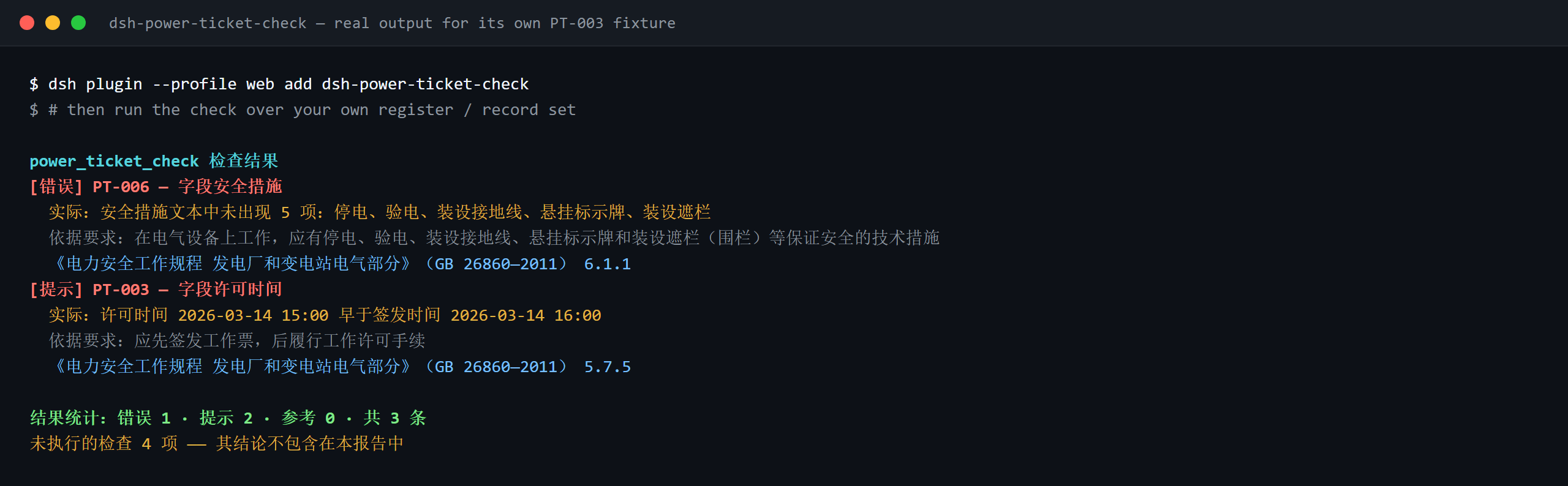
Real output from this plugin over its own PT-003 test fixture — not a mock-up. The rule pack ships no invented quotations, so a finding names both the clause it applied and the fact that the clause text was not obtained.
What it answers
| You ask | What it answers |
|---|---|
| Out of the box it passes every ticket I run through it — why? | Because PT-001 reports itself in skipped, not as a pass. Its requiredFields list ships empty, so the rule cannot run; fill it with the columns your own form requires. Even when configured, PT-001 checks that a column is filled, not that the value in it is correct, and it sits at info. |
| The ticket is a 电气第一种工作票 but the 工作性质 mentions 带电作业 — is that a contradiction it reports? | No. PT-002 reports only two things: that the 工作票种类 is missing, or that it is not among the kinds your deployment lists. Its ticketKinds list ships empty and the rule then reports itself in skipped, exactly as PT-005 does when its exclusiveRolePairs list is empty; the plugin does not decide which kind of ticket a job needs. Once you fill those lists, configure PT-005 with the pair 工作许可人 and 工作负责人 to have the same person in both columns reported. Neither rule judges anyone's qualification or whether holding two roles was approved. |
| The 许可时间 is written earlier than the 签发时间, and one time column will not parse. | PT-003 reports both: 许可时间 earlier than 签发时间, 终结时间 earlier than 许可时间, and any unreadable column as 无法解析为日期时间, expecting a form such as 2026-03-15 08:30. Both ends are converted to an absolute minute count, so a ticket spanning midnight compares correctly. If 签发时间 or 许可时间 cannot be read at all, the rule reports itself in skipped, because the order check cannot be established. It never checks whether the work actually followed the ticket, and an optional interval or duration limit is yours to configure. |
| The 延期时间 is earlier than the 计划结束时间, so the extension shortens the job rather than lengthening it. | PT-004 reports it, and also reports a 延期时间 earlier than the 许可时间. The standard sets no ceiling on how long or how often a ticket may be extended, so the rule carries no quantitative limit and does not check whether the extension formalities were completed. |
| The 安全措施 column is filled in but mentions only 停电 and 验电. | PT-006 reports the three missing terms one by one. It is the only rule here at error, because its clause 6.1.1 sits in the mandatory chapter, and it checks that the five measures are written on the ticket, not that they match the site or were carried out. If no readable measure column is found it reports itself in skipped. |
| Nothing on the ticket shows that the 工作许可人 went to the site again with the 工作负责人. | PT-007 reports which of the three permit-formality terms are absent from the text it reads, that text being the permitColumns plus the names in the role columns. It reads wording only: it cannot tell whether the site re-check really happened, and an institution that wants this to block can raise the rule's severity in the pack without a code change. |
Standards it follows
| Document | Number | Cited by rules |
|---|---|---|
| 《电力安全工作规程 发电厂和变电站电气部分》 | GB 26860—2011 | PT-001, PT-002, PT-003, PT-004, PT-005, PT-006, PT-007 |
Boundary: this plugin checks one 电力工作票 for what a form can be held to — that the required boxes are filled, that 签发 / 许可 / 终结 happened in an order that is physically possible, that 延期 moves the end forward, and that roles you require to be separate are held by different people. It does not judge whether the safety measures written on the ticket were adequate, does not say which kind of ticket a job needs, and does not verify that anyone's qualification is real.
⚠️ Three things this plugin refuses to do, and the effect tier that fixes its severities
1. It respects the standard's own effect tier. GB 26860—2011's foreword says, verbatim, 「本标准的第5章和7.3.4为推荐性,其余为强制性」 — the work-ticket regime sits in the recommendatory chapter 5. So every rule resting on chapter 5 ships at
warnorinfoand nothing there can block a workflow.PT-006(the five safety technical measures, clause 6.1.1) is the onlyerror, because chapter 6 is mandatory.PT-007(the permit formalities, clause 5.5.1) is awarn; its note explains that an institution which wants those formalities to block can raise it by editing the rule pack, with no code change. A test asserts both directions: no chapter-5 rule is anerror, andPT-006is the sole one.2. It does not adopt three claims that have no basis in the standards. After reading GB 26860—2011 and GB 26859—2011 in full: there is no "第一种工作票应工作前一日送达" deadline anywhere; 5.3.12 and 5.4.10 say only 「延期应办理手续」 with no ceiling on duration or count; and the statutory name is 紧急抢修单 (5.2.4), not "事故应急抢修单". A test asserts the pack records all three.
3. It does not treat the ticket layout as mandatory. 5.1.2 says the ticket "可包含" those items, and appendices A–D are marked 资料性附录 (informative) in the standard's contents. So
PT-001ships with an empty field list for you to fill from your own form, and reports atinfo.Two more lists are yours:
PT-002's ticket kinds andPT-005's exclusive role pairs. Both ship empty. The plugin never judges whether the safety measures written on a ticket were adequate, which ticket kind a job needs, or whether anyone's qualification is real — the standard sets out roles' duties (5.4.1–5.4.5) and no qualification conditions.
Compatibility
| Surface | Status |
|---|---|
| Harness | Peer range >=0.1.2-rc.1 <0.2.0 || >=0.2.0-0 <0.3.0 — verified to accept both 0.2.0-rc.2 and 0.2.1-alpha.1. engines.dsh is deliberately not declared: it has no reader and cannot reject a host |
| Node | `^22.19.0 |
| Platforms | All (plain ESM; no native code, no network, no model call) |
| Tool mode | Works in native, ptc and both; for a month of tickets use ptc |
What it does
Registers the power_ticket_check tool. It reads one ticket as a flat mapping of the ticket's own column
names to their values, applies a versioned rule pack, and returns a report.
| Rule | Check | Severity | Basis kind |
|---|---|---|---|
PT-001 |
every configured column is filled (off by default, informative layout) | info | local |
PT-002 |
the ticket kind is one you use, and matches the work's nature | warn | direct |
PT-003 |
签发 → 许可 → 终结 is a possible order; optional interval and duration limits | warn | principle |
PT-004 |
延期 moves the end forward and follows the permit | warn | direct |
PT-005 |
roles you require to be separate are held by different people (off by default) | warn | direct |
PT-006 |
the five safety technical measures are written on the ticket | error | direct |
PT-007 |
the permit formalities (site re-check, live parts pointed out, both signatures) | warn | direct |
Install
dsh plugin --profile <name> add dsh-power-ticket-check
dsh --profile <name> --dump-config | grep 'dsh-power-ticket-check'
Configuration
| Key | Type | Default | Description |
|---|---|---|---|
rulesFile |
string | rules/power-ticket-check.yaml |
Rule-pack path, relative to the package root |
disabledRules |
string[] | [] |
Rule ids to stop running; each appears in skipped |
onlyRules |
string[] | [] |
Run only these rule ids; empty runs every rule |
skipNotes |
string | "" |
Note appended to every skipped reason |
timeoutMs |
number | 120000 |
Cooperative tool timeout budget |
Rule-level parameters worth knowing:
PT-001requiredFields— the columns that must be filled, using the same names the material uses.PT-002ticketKinds— your ticket kinds, e.g.[第一种工作票, 第二种工作票, 带电作业票]. It can also be passed per call.PT-003minMinutesBeforeWork— the least interval you require between 签发 and 许可.0disables the interval comparison.PT-003maxDurationHours— the longest a single ticket may run.0disables the duration check.PT-005exclusiveRolePairs— pairs that must not be the same person, written['工作票签发人|工作许可人'].
Material format
The tool accepts JSON or YAML. One ticket is one flat mapping:
工作票编号: DL-2026-0001
工作票种类: 第一种工作票
工作地点: 35kV 某某变电站
工作任务: 10kV 某某线 01 号杆更换隔离开关
计划开始时间: 2026-03-15 08:00
计划结束时间: 2026-03-15 18:00
签发时间: 2026-03-14 16:00
许可时间: 2026-03-15 08:30
终结时间: 2026-03-15 17:00
工作票签发人: 张工
工作负责人: 李工
工作许可人: 王工
Times are accepted as 2026-03-15 08:30 or as a bare date, in which case midnight is assumed and the
report says so when that matters. Role columns may carry a suffix — 工作负责人签名 is recognised as the
工作负责人 role — so a form exported with its signature boxes still maps cleanly.
The chronology check compares both ends on one continuous timeline, so a permit that falls on an earlier day is reported as an earlier instant, not as a small negative same-day interval.
Rule sources
Rule data lives in rules/power-ticket-check.yaml. Every rule carries a document, a document number, a
clause in the source's own numbering, a verbatim excerpt and the URL the excerpt was read from. The
loader enforces that an excerpt is a real quotation of at least eight characters, and that a check
resting on a general principle or a local policy can never be declared error.
The clauses quoted come from GB 26860—2011《电力安全工作规程 发电厂和变电站电气部分》 — 5.1.2, 5.2.1–5.2.4, 5.3.7, 5.3.12, 5.5.1, 5.7.5 and 6.1.1 — with the standard's foreword providing the effect tier that fixes each rule's severity. The clause text was obtained from a full-text scan transcription and cross-checked verbatim against a second independent site.
Current standards in this family, all verified against the standards platform:
| Standard | In force | Note |
|---|---|---|
| GB 26860—2011 发电厂和变电站电气部分 | 2012-06-01 | mandatory, except chapters 5 and 7.3.4; a revision is "being approved" |
| GB 26859—2011 电力线路部分 | 2012-06-01 | the line-side counterpart |
| DL/T 408—2023 发电厂和变电站电气部分 | 2024-06-28 | replaces DL 408—1991, runs alongside GB 26860 — not a replacement for it |
| DL/T 409—2023 电力线路部分 | 2024-06-28 | |
| DL/T 560—2022 高压试验室部分 | 2022-11-13 | replaces DL 560—1995 |
DL/T 408—2023's clause text could not be obtained, so this pack cites none of it. Its identity and
chapter structure were verified, and DL/T 408—2023 renames 紧急抢修单 to 故障紧急抢修单 and adds 带电作业票 and
双签发 — which is why PT-002 accepts both names rather than picking one.
The full clause-verification report, including the sources that were checked and rejected, is in
rules/evidence/clause-verification.md.
Troubleshooting
PT-001,PT-002orPT-005report themselves as skipped. Their lists are empty. Fill in the ones your enterprise's rules require.PT-003reports nothing about order. 签发时间 and 许可时间 are not both present; the rule says so inskipped. If a time is present but unreadable, the rule reports that instead of skipping, so an unparseable cell never hides the check.PT-003fires on a duration that is normal for us.maxDurationHoursis0by default; if you set it, it applies to every ticket the tool sees. Leave it at0if your tickets legitimately run long.PT-005misses a case I know about. Add the role pair. The plugin compares only the pairs you list, because which roles must be separate depends on the ticket kind and your implementing rules.- The plugin installs but the tool never appears. Check that
mainresolves tolib/index.mjsand thatpnpm run buildproduced it; a wrongmainmakes the loader skip the entry silently. dsh plugin addrefuses the package as incompatible. The peer range covers0.1.xand0.2.x; if your runtime sits outside it, grant an explicit exemption:dsh plugin --profile <name> allow-version [email protected] --dsh-version <runtime> --accept-riskcheckreportsmanifest-peersas failed. The static checker compares against a hard-coded peer range that predates the 0.2 line. The runtime enforces peer compatibility at install time, so the declared range is the correct one; this is a known upstream issue indsh-plugin-dev.
Development
pnpm install
pnpm run typecheck   # tsc --noEmit
pnpm test            # vitest, paired fixtures per rule
pnpm run build       # tsdown -> lib/index.mjs + lib/index.d.mts
node ../scripts/sync-shared.mjs dsh-power-ticket-check   # refresh src/shared from ../_shared
License
Apache License 2.0 © 2026 dsh-power-ticket-check contributors.