dsh-repair-order-qc
Verifieddsh-repair-order-qc · v0.2.5 · Apache-2.0
维修工单结算核对(按项目金额、配件工时合计与结算总额核对算术自洽,仅提示差异,不作出定性结论)
Install
dsh plugin add dsh-repair-order-qc Confirm the layer applied with dsh --profile default --dump-config — see the install guide.
Source
Tags
Readme
dsh-repair-order-qc — Motor-vehicle repair work-order register and settlement arithmetic check

dsh-repair-order-qc reads one motor-vehicle repair work-order register — the vehicle header plus one row per item line — and checks that register's own completeness and arithmetic: that the customer's report and the work done are recorded, that the item name column is filled, that quantity, unit price and amount are parseable, that amount equals quantity × unit price, that the line amounts total the settlement figure, that the settlement figure equals parts plus labour less discount, that the receipt date does not fall after the delivery date, that work-order numbers are unique in the register, and that no template placeholder survives in the item name column.
What it looks like
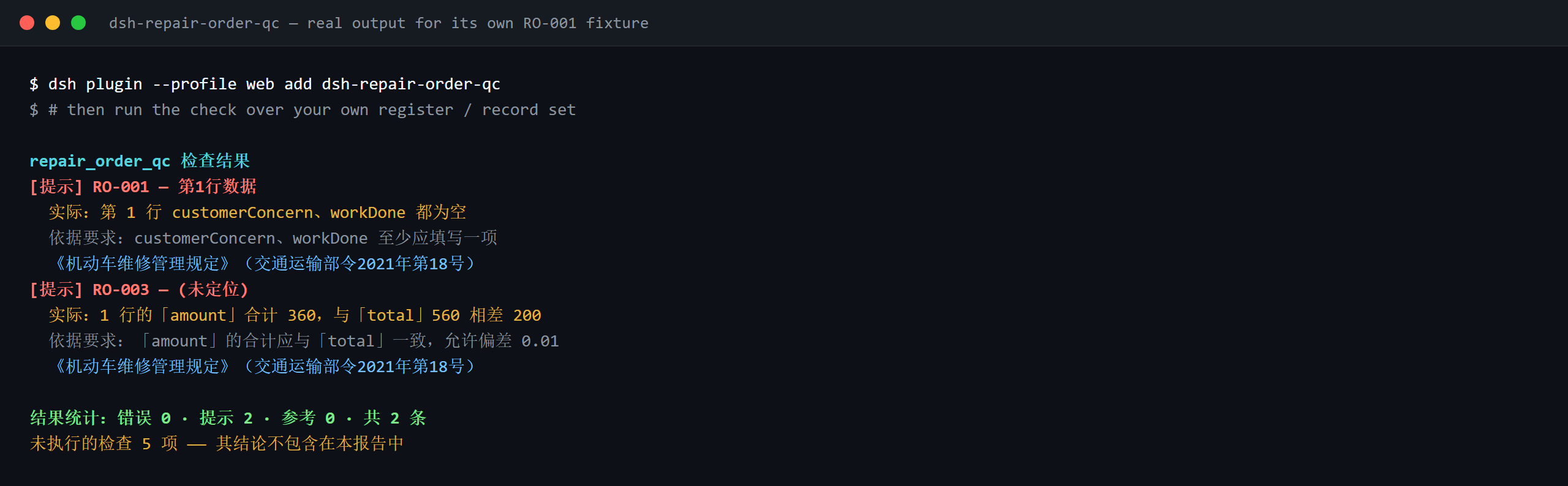
Real output from this plugin over its own RO-001 test fixture — not a mock-up. The rule pack ships no invented quotations, so a finding names both the clause it applied and the fact that the clause text was not obtained.
What it answers
| You ask | What it answers |
|---|---|
| A line says quantity 2, unit price 180, and an amount of 400 — does the check notice? | Yes. RO-002 reports that row, because 2 × 180 = 360 while the amount cell says 400. The rule runs only when quantity, unit price and amount all parse as numbers, and its tolerance is 0.01 for rounding. It does not judge whether the unit price is reasonable or whether the item should have been charged at all. |
| The line amounts do not add up to the settlement figure written in the header of the material. | RO-003 adds the amount column and compares that total with the settlement figure total stated in the material header, reporting how many rows it summed and how large the gap is. The tolerance is 0.01. It only performs that addition; it does not judge whether the individual charges are reasonable. |
| Our work orders carry no parts total and no labour total — can the plugin still tell me the settlement figure is wrong? | No, and it says so. RO-004 checks parts plus labour less discount against the settlement figure and reports itself in skipped when the material carries no partsTotal and laborTotal totals, instead of assuming a composition. Its discount column means a reduction amount; a register that records a discount rate should disable the rule or use another check. |
| The delivery date is earlier than the receipt date. | RO-005 reports that row: it compares the receipt date with the delivery date and reports the row when receipt falls after delivery. The same day counts as not later, a date it cannot parse is reported on its own row rather than passed over in silence, and it does not judge whether the repair took a reasonable length of time. |
| The same work-order number appears on two rows. | RO-006 reports the repeated number, because it would double-count the fees and break the link between a work order and its archive; whitespace is ignored when comparing. One work order spread over several item lines is a legitimate shape — distinguish those rows in the item name column instead of repeating the number. The rule checks uniqueness only. |
| The item name cell still reads 【】 or 待填. | RO-007 reports the residual placeholder, because a work order with no real item cannot be settled. The terms list it looks for is the one in its own rule pack and can be adjusted to your template. It only checks whether those literal strings appear, not whether the wording is apt. |
Standards it follows
| Document | Number | Cited by rules |
|---|---|---|
| 《机动车维修管理规定》 | 交通运输部令2021年第18号(2005 年公布,经 2015、2016、2019、2021 年四次修正,自 2005 年 8 月 1 日起施行) | RO-001, RO-002, RO-003, RO-004, RO-005, RO-006, RO-007 |
Boundary: this plugin checks a 机动车维修工单 for arithmetic and completeness — that the customer's report and the work performed are recorded, that a line's amount equals quantity × unit price, that the line amounts total the settlement figure, that the settlement figure equals parts plus labour less discount, that delivery does not precede receipt, that work-order numbers are used consistently, and that no placeholder survives. It does not decide whether a repair was necessary, whether a charge is reasonable, whether there was over-servicing, or whether the work was done properly.
⚠️ It checks arithmetic, not the repair
A work order with perfectly consistent figures for work that should never have been sold passes this plugin. Judging necessity and price needs the vehicle's actual condition, the technical standards and the repair contract — this plugin has none of them.
The labour rate comes from the register or your configuration. No rate standard is built in. The plugin does not check whether a part is genuine either; it reports what the register says.
Two arithmetic rules read the register's composition, and both say so when they cannot run:
RO-002verifies金额 = 数量 × 单价, and reports itself inskippedunless all three cells parse. Its tolerance is0.01, for rounding.RO-004verifies配件费合计 + 工时费合计 − 折扣 = 结算总额. The subtraction is expressed as a per-term sign in the rule pack (signs: [1, 1, -1]) rather than a negative scale, so the finding reads like the arithmetic a person would write. A register with no parts/labour breakdown leaves the rule unrun instead of assuming a composition.Every
excerptin the rule pack says, in so many words, that the clause text was not obtained. The regime lives in 《机动车维修管理规定》 and GB/T 16739. The verification pass could not retrieve verbatim clause text, so the pack states the gap in theexcerptfield itself and keeps every rule atwarnorinfo. When the texts are in hand, replace eachexcerptwith the real clause and raisekindtodirect.
Compatibility
| Surface | Status |
|---|---|
| Harness | Peer range >=0.1.2-rc.1 <0.2.0 || >=0.2.0-0 <0.3.0 — verified to accept both 0.2.0-rc.2 and 0.2.1-alpha.1. engines.dsh is deliberately not declared: it has no reader and cannot reject a host |
| Node | `^22.19.0 |
| Platforms | All (plain ESM; no native code, no network, no model call) |
| Tool mode | Works in native, ptc and both; for a month of orders use ptc |
What it does
Registers the repair_order_qc tool. It reads one repair-order register — the vehicle header plus one row per
item line — applies a versioned rule pack, and returns a report.
| Rule | Check | Severity | Basis kind |
|---|---|---|---|
RO-001 |
the report and the work performed are recorded | warn | direct |
RO-002 |
a line's amount equals quantity × unit price | warn | direct |
RO-003 |
line amounts total the settlement figure | warn | direct |
RO-004 |
the total equals parts + labour − discount | warn | direct |
RO-005 |
delivery does not precede receipt | warn | principle |
RO-006 |
work-order numbers are used consistently | warn | principle |
RO-007 |
the item column holds no unreplaced placeholder | warn | principle |
Install
dsh plugin --profile <name> add dsh-repair-order-qc
dsh --profile <name> --dump-config | grep 'dsh-repair-order-qc'
Configuration
| Key | Type | Default | Description |
|---|---|---|---|
rulesFile |
string | rules/repair-order-qc.yaml |
Rule-pack path, relative to the package root |
disabledRules |
string[] | [] |
Rule ids to stop running; each appears in skipped |
onlyRules |
string[] | [] |
Run only these rule ids; empty runs every rule |
skipNotes |
string | "" |
Note appended to every skipped reason |
timeoutMs |
number | 120000 |
Cooperative tool timeout budget |
Rule-level parameters worth knowing:
RO-002resultField/factorFields/tolerance— the line arithmetic.RO-003field/headerField/tolerance— the column summed and the header figure it must match.RO-004expression— the composition, as{ "op": "sum", "fields": [...], "signs": [1, 1, -1] }. Change the signs if your settlement composes differently; if you charge a discount rate rather than an amount, disable the rule.RO-007terms— the placeholders to look for.
Material format
The tool accepts JSON or YAML:
customer: 某某客户
vehicle: 某某车型
mileage: '48600'
partsTotal: '360'
laborTotal: '200'
discount: '0'
total: '560'
rows:
  - { 工单号: WX-2026-0018, 进厂日期: 2026-03-02, 出厂日期: 2026-03-04,
      项目名称: 前制动片, 数量: '2', 单价: '180', 金额: '360',
      客户反映: 刹车时有异响, 施工内容: 更换前制动片一副并试车 }
Column names are matched case-insensitively and ignoring spaces, underscores and hyphens; the register's own column names are kept, so a finding names the column it read. Figures stated once for the whole order (the parts and labour totals, the settlement figure) may live in the header, and the arithmetic checks find them.
Rule sources
Rule data lives in rules/repair-order-qc.yaml. The pack's header states the citation gap in full, and each
rule's note repeats the part that matters for that rule. The load-time guard that normally enforces "an
excerpt must be a real quotation of at least eight characters" cannot tell a quotation from a description —
so this pack leans on the header, the per-rule notes and a test that asserts every excerpt admits the gap.
Troubleshooting
RO-004reports itself as skipped. The register carries no parts or labour total, so there is no composition to check. The plugin will not assume one.RO-004fires on a settlement I know is right. The parts/labour/discount figures disagree with the total. Check whether your discount is a rate rather than an amount — if so, disable the rule.RO-002fires on a line I consider rounded. The default tolerance is0.01; raise it if your pricing rounds more coarsely.RO-006fires twice on one work order. One order with several item lines is normal — leave the order number shared. The rule fires only when the same number appears on rows you meant as separate orders; if your register shares the number across lines by design, disable the rule.- The plugin installs but the tool never appears. Check that
mainresolves tolib/index.mjsand thatpnpm run buildproduced it; a wrongmainmakes the loader skip the entry silently. dsh plugin addrefuses the package as incompatible. The peer range covers0.1.xand0.2.x; if your runtime sits outside it, grant an explicit exemption:dsh plugin --profile <name> allow-version [email protected] --dsh-version <runtime> --accept-riskcheckreportsmanifest-peersas failed. The static checker compares against a hard-coded peer range that predates the 0.2 line. The runtime enforces peer compatibility at install time, so the declared range is the correct one; this is a known upstream issue indsh-plugin-dev.
Development
pnpm install
pnpm run typecheck   # tsc --noEmit
pnpm test            # vitest, the shared table-plugin suite plus paired fixtures
pnpm run build       # tsdown -> lib/index.mjs + lib/index.d.mts
node ../scripts/sync-shared.mjs dsh-repair-order-qc   # refresh src/shared from ../_shared
The plugin is data-only: src/model.ts declares the table shape, the shared kit supplies the reader and
the check engine, and the rule pack declares every check.
License
Apache License 2.0 © 2026 dsh-repair-order-qc contributors.