dsh-s1
Verifieddsh-s1 · v0.2.0 · MIT
Native s1 tools for the DeepSeek Harness (DSH), registered as first-class tools (s1_search, ...).
Install
dsh plugin add dsh-s1 Confirm the layer applied with dsh --profile default --dump-config — see the install guide.
Source
Tags
Creators
Readme
dsh-s1

Native s1 tools for the DeepSeek Harness (DSH).
Unlike the MCP server (search1api-mcp, a generic bridge that surfaces as
mcp__search1api__*) or the CLI skill (which teaches the model to shell out to
s1), this package registers first-class DSH tools named s1_* — same
layer as read, bash, subagent, workflow. Calls run in-process against
the official @search1api/client SDK.
Tools
| Tool | Backed by | Status |
|---|---|---|
s1_search |
Search1API.search() |
✅ |
s1_news |
Search1API.news() |
✅ |
s1_ask |
Search1API.ask() |
Ready |
s1_crawl |
Search1API.crawl() |
✅ |
s1_sitemap |
Search1API.sitemap() |
✅ |
s1_trending |
Search1API.trending() |
✅ |
Not yet implemented: s1_screenshot (needs DSH attachment/image support) and
s1_deepcrawl (long-polling task).
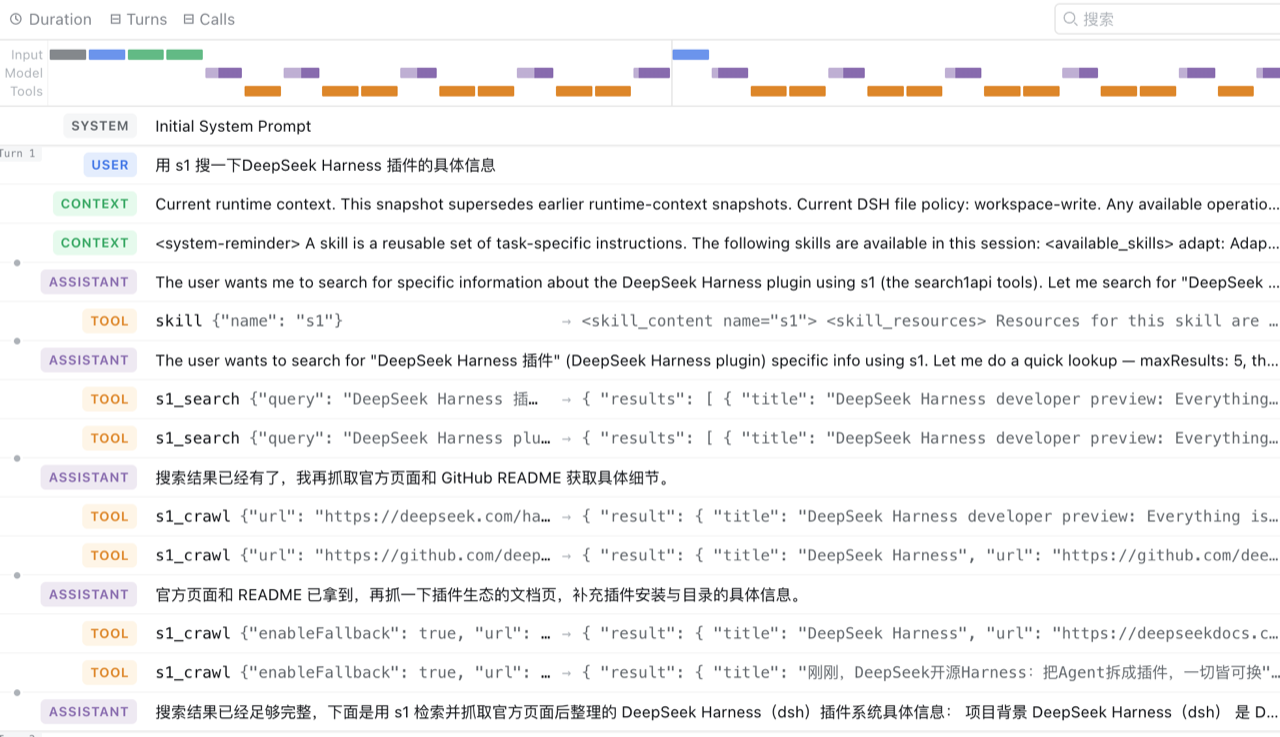
Skill
The package also bundles a s1 skill (ctx.skills.register), which teaches the
model how to pick the right tool and tune parameters — quick lookup vs deep
research, source/recency signals, Chinese-query engine choice, and when to
follow a search result with s1_crawl. It is registered with the tools and can
be disabled independently via skill: false.
Architecture
@search1api/client  (official SDK, in-process)
        │ import
dsh-s1              (Cordis plugin: name/inject/apply)
        │ loaded by the `s1-tools` row in cordis.patch.yml
ctx.tools.register(defineTool({ name: "s1_search", ... }))
        │
DSH model sees `s1_search` as a native tool
The package is both the bundle (its dsh.bundle.patch → cordis.patch.yml)
and the plugin (its main entry exports name/inject/apply). The patch
inserts a single loader row that references the package itself:
- insert:
    - id: s1-tools
      name: 'dsh-s1'
Install into a DSH profile
First publish (or npm link / local path) the package, then:
dsh plugin --profile web add dsh-s1
For a local checkout, use a path spec (the plugin command anchors relative paths to your invoking directory):
cd /Volumes/More/Products/search1api/ecosystem/dsh-s1
npm run build                      # produce lib/index.js + lib/index.d.ts
cd ~/.dsh
dsh plugin --profile web add file:/Volumes/More/Products/search1api/ecosystem/dsh-s1
dsh plugin reconciles dsh.profile.bundles: because this package declares
dsh.bundle.patch, it is appended to the profile's bundle stack automatically.
Authentication
The SDK reads its key lazily, so a missing key fails the tool call (not plugin activation). There is exactly one credential variable:
export S1_KEY=...
OAuth (roadmap — not implemented yet)
s1's API accepts Authorization: Bearer <token> for both an API key
and an OAuth access token, so the transport layer is token-agnostic. The OAuth
flow (browser login, PKCE, token storage, refresh) currently lives only in
search1api-cli (s1 login + auth.ts); @search1api/client does not yet
expose it. The DSH plugin will support OAuth by reusing or sinking that flow,
rather than re-implementing it — tracked separately from this skeleton.
Config
| Key | Default | Description |
|---|---|---|
search |
true |
Register s1_search. |
news |
true |
Register s1_news. |
ask |
true |
Register s1_ask (5 credits per call). |
crawl |
true |
Register s1_crawl. |
sitemap |
true |
Register s1_sitemap. |
trending |
true |
Register s1_trending. |
skill |
true |
Register the bundled s1 skill. |
Development
npm install
npm run typecheck
npm run build
Current API capabilities
Search supports bingcn, yandex, and grokipedia; sogou is removed.
Search and news support day, week, month, and year. Search accepts
page on engines with native pagination.
The default Ask tool accepts only a natural-language query. The server
chooses engines and a time window and returns query, intent, ranked
results, and errors. Ask results include source and relevance; this
endpoint returns search results rather than a generated answer. Each call
costs 5 credits. Use ordinary search when the engine and keywords are known.
Engine-specific search/news attributes stay inside optional per-result
metadata: GitHub uses kind, stars, language, and num_comments;
Hacker News news results use story_url, points, and num_comments.
published_date stays optional at the result top level. Zero counts are
preserved and unavailable fields are omitted. Credit Grokipedia results as
"Powered by xAI".
s1_ask is enabled by default; set ask: false to disable it. Requires
@search1api/client>=0.4. Citable output maps link to url while keeping
dates, metadata and Ask scores.