dsh-t3-new-session-screen
Verifieddsh-t3-new-session-screen · v1.0.0 · MIT · Web UI
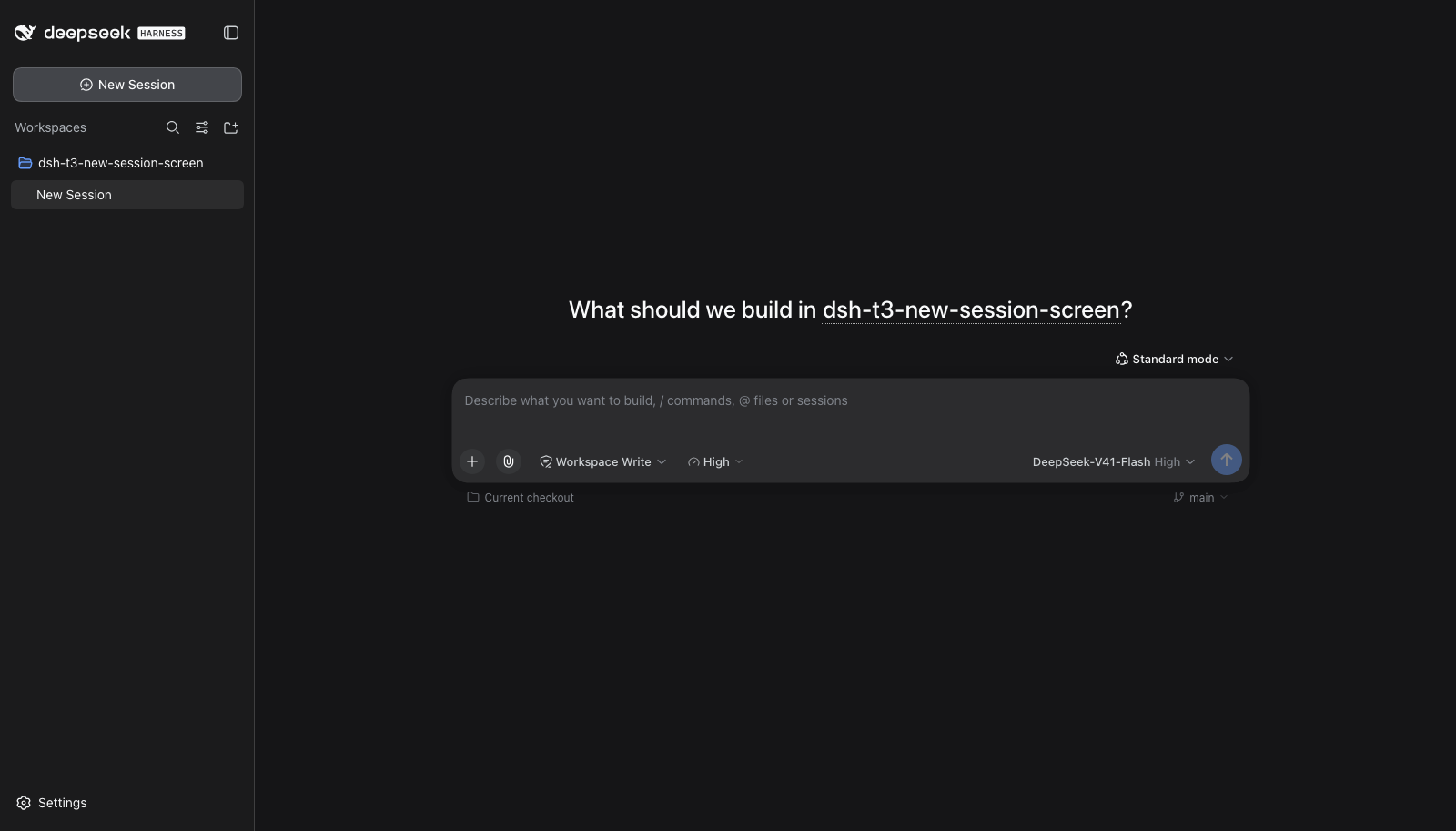
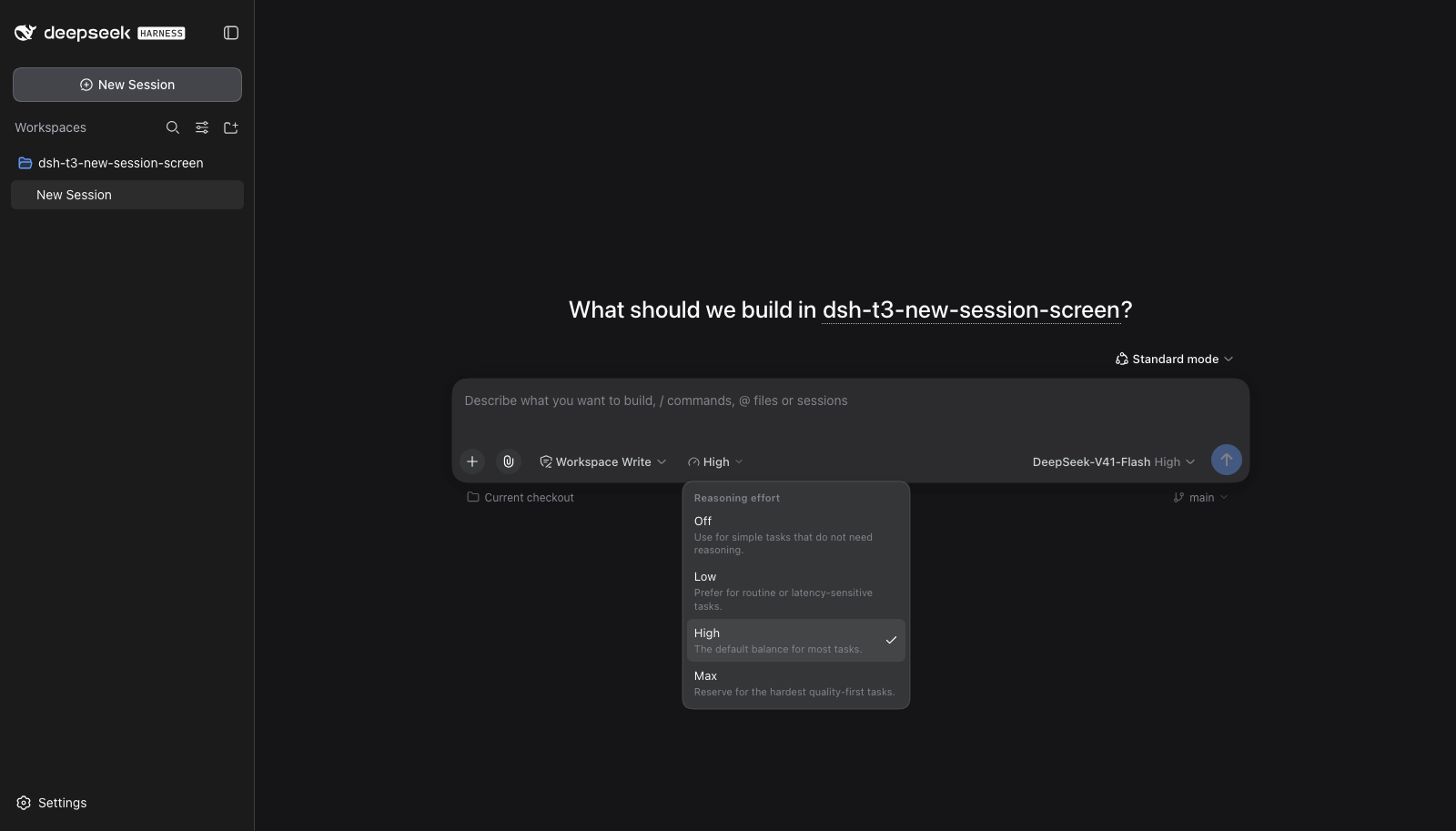
T3 Code's New Session screen for DeepSeek Harness: the "What should we build in <project>?" headline with an inline project dropdown, a reasoning-effort picker and a git branch picker in the composer.
Install
dsh plugin add dsh-t3-new-session-screen Confirm the layer applied with dsh --profile default --dump-config — see the install guide.
Source
Tags
Readme
dsh-t3-new-session-screen
T3 Code's New Session screen for the DeepSeek Harness composer.
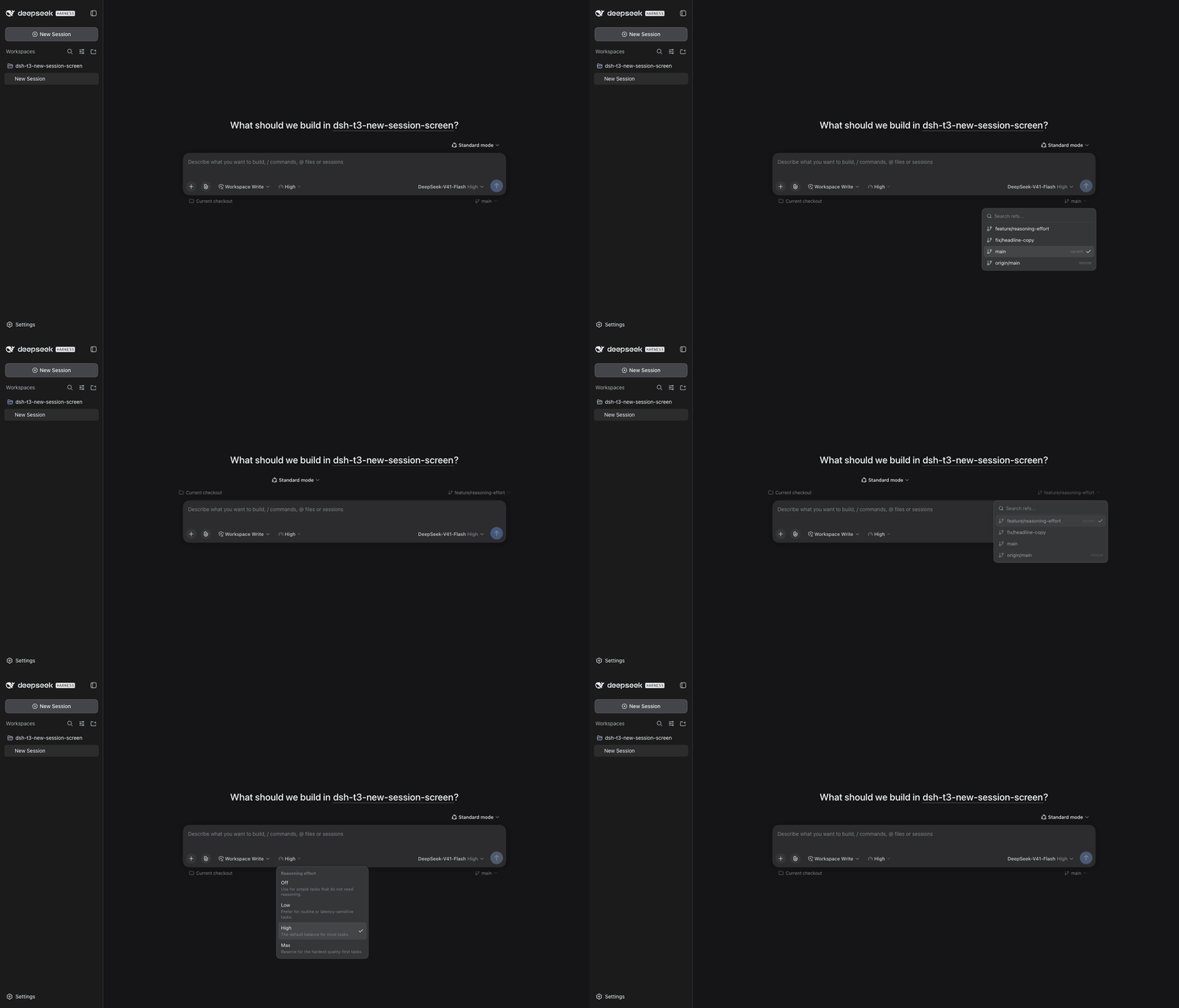
Three things that screen has and DeepSeek Harness's blank session does not:
What should we build in <project>?— the headline from T3'sDraftHeroHeadline, where the project name is itself the picker.- A reasoning-effort picker — T3's
TraitsPicker, surfaced in the composer tool row instead of hidden behind the model menu. - A git branch picker — T3's
BranchToolbar, with realgit checkout.
Credit
The screen this plugin implements is T3 Code's. The headline sentence and its inline project control, the effort picker's shape, and the branch strip with its searchable ref menu are all theirs. T3 Code is open source under MIT; this port keeps the same behaviour and swaps the data underneath for DeepSeek Harness's own services. Please support the original project.
Features
- The headline.
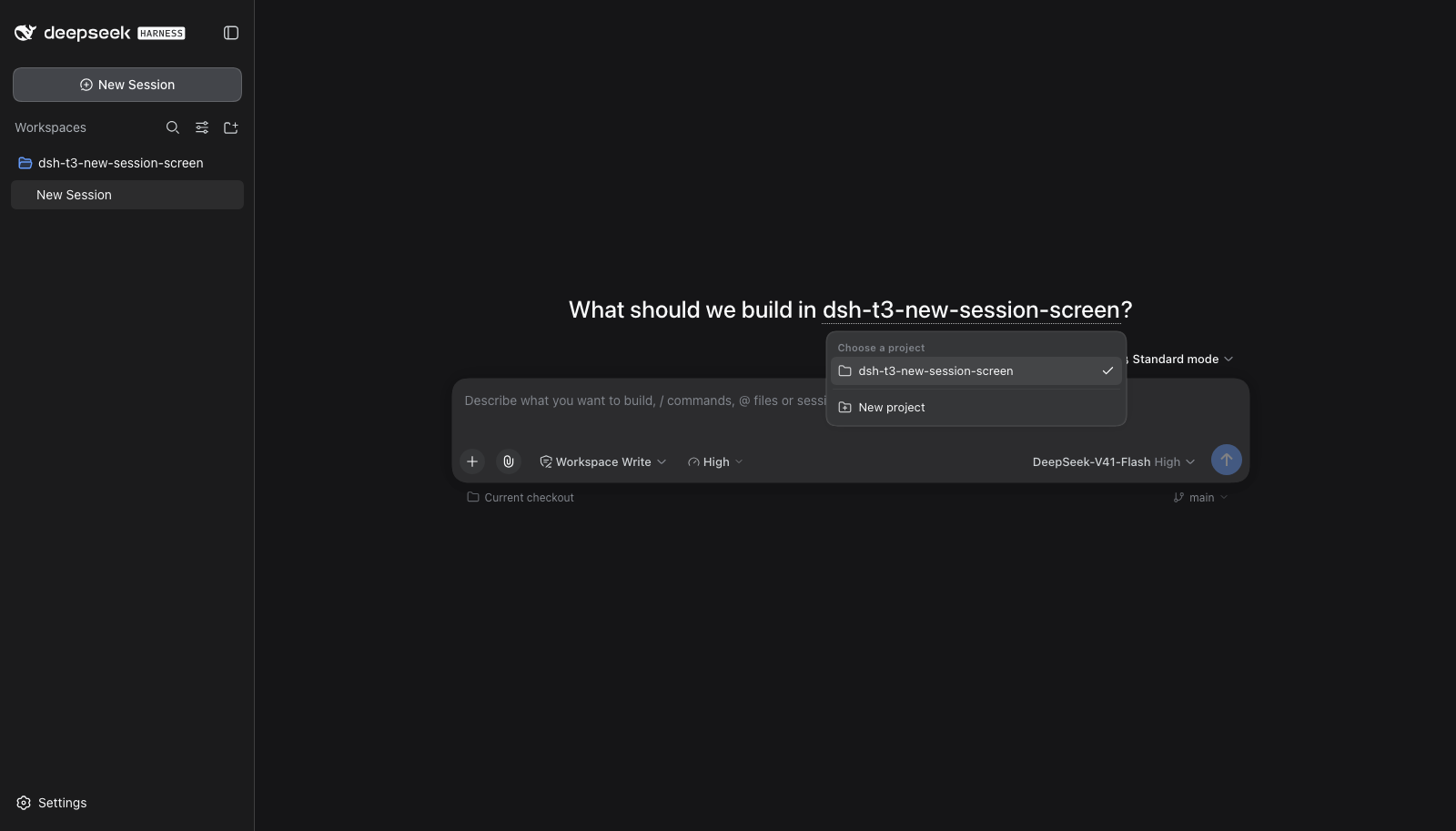
What should we build in <project>?, centred over the composer, with the project name underlined and clickable. Clicking it opens a T3-shaped project menu: every registered workspace, a check on the current one, a divider, and New project. Picking a project moves the blank session to it. DSH renders its own headline from a literal string with no slot, so this plugin fills the only additive hole in that row (conversation.hero.brand.mark) and suppresses the shipped title beside it. The template is configurable, and{project}marks where the control goes. - Reasoning effort. A gauge control in the composer tool row showing the
level the current model is actually using (
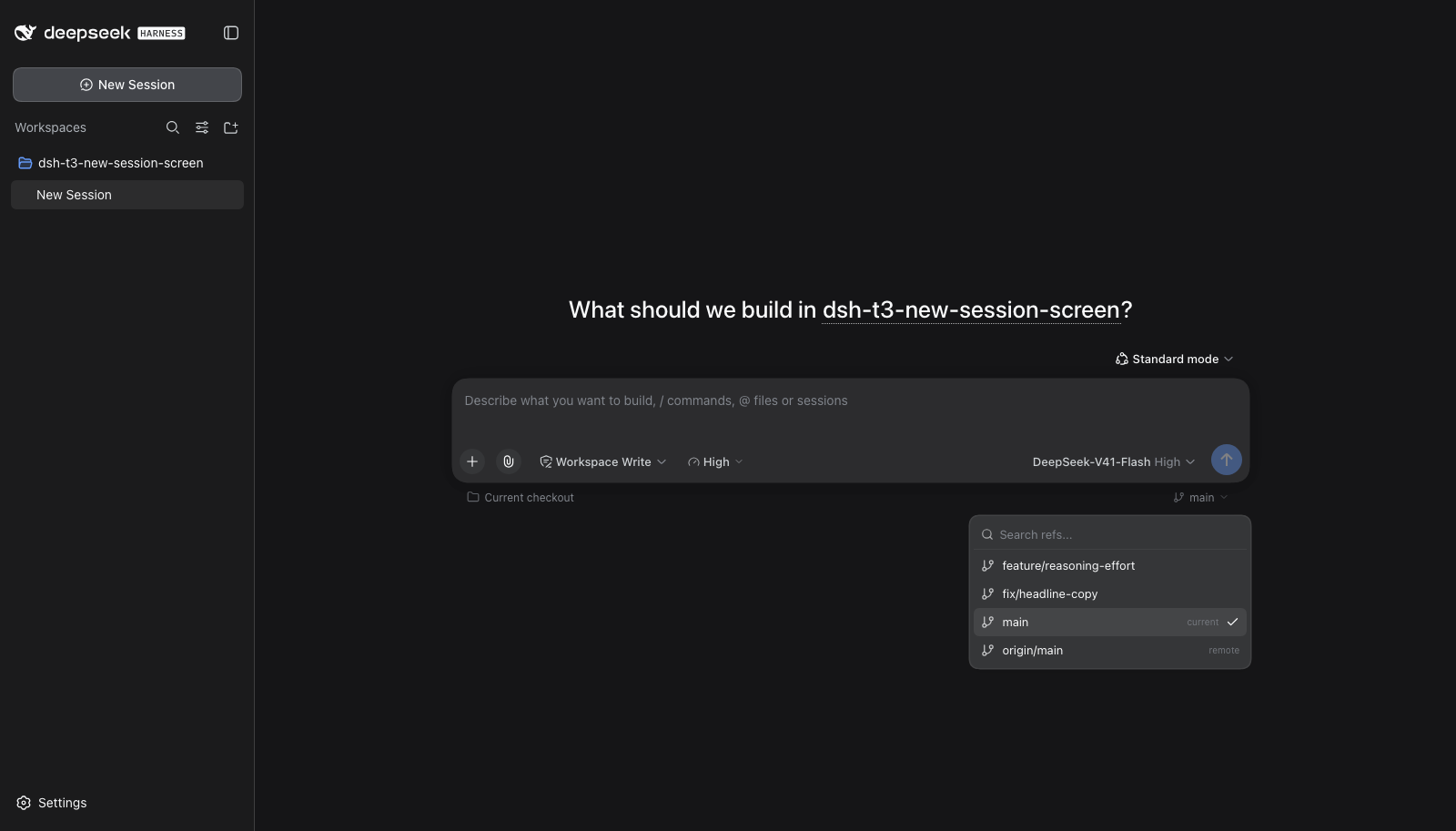
Off,Low,High,Maxfor DeepSeek's own models). The menu carries each level's description and a check on the current one. It reads and writes the same per-session model directory the model seat uses, so the model seat's own label updates with it. A model that advertises no effort levels renders no control at all — effort is a per-model capability, not a global preference. - Git branch. A strip under the composer card: the checkout on the left, the
current ref on the right. The ref menu searches, lists local and remote refs,
labels
current/default/remote, and switches withgit checkout <ref>. A Create new ref row appears once the query names a ref that does not exist yet, and runsgit checkout -b. DSH ships no git surface of any kind, so every fact here comes from this bundle's Host half. The strip is aligned on the composer's shared width axis, not on the card — see Alignment.
Screenshots
| The New Session screen | Project menu | Branch picker | Reasoning effort |
|---|---|---|---|
 |
 |
 |
 |
Install
From this repository:
dsh plugin --profile web add github:yusufameri/dsh-t3-new-session-screen
Once the package is on npm, the registry form is one word shorter:
dsh plugin --profile web add dsh-t3-new-session-screen
Either reconciles the profile's bundle list, so the next boot merges the plugin's patch and loads its client half. Removing the bundle restores the shipped headline, model seat and composer with no residue.
Configuration
Every field is optional; the defaults render the whole screen. Set them on the
bundle's row in the profile's cordis.patch.yml:
- id: t3-new-session-screen
  name: 'dsh-t3-new-session-screen'
  config:
    headlineText: 'What should we build in {project}?'
    effortSlot: right
    branchCreateEnabled: false
| Key | Default | Meaning |
|---|---|---|
headlineEnabled |
true |
Replace the blank-session headline with the T3 sentence. |
headlineText |
What should we build in {project}? |
Headline template; {project} becomes the interactive project name. Without the hole the sentence renders as plain text. |
hideShippedHeadline |
true |
Hide DSH's own "Into the Unknown" title beside the headline. |
hideWorkspaceChip |
true |
Hide the shipped workspace chip under the headline, which the headline supersedes. |
effortEnabled |
true |
Reasoning-effort picker in the composer tool row. |
effortSlot |
left |
Which composer seat the effort picker occupies: left (beside the permission and plan controls) or right (beside the model seat). |
branchEnabled |
true |
Git branch strip under the composer, on the new-session screen and in an active session. |
branchCreateEnabled |
true |
Offer Create new ref (git checkout -b) in the branch picker. |
gitEnabled |
true |
The git bridge behind the branch strip. Turning it off leaves the strip absent. |
gitTimeoutMs |
30000 |
Budget of one git child process. |
The client half reads the resolved configuration from the Host over the same route the branch data uses, so a change takes effect on the next page load.
How it works
The whole screen is contributed through DSH's own seams.
| Piece | Seam |
|---|---|
| Headline | conversation.hero.brand.mark (single, root) — the only additive hole in DSH's headline row. |
| Project menu | conversation.hero.workspace (single, root) at priority -1, which shadows the shipped WorkspacePicker in the same cell. |
| Project roster | The root useWorkspaces standard hook, fed by ctx.slots.provideRoot. |
| New project | ctx.uiWorkspace.pickDirectory() then ctx.workspaces.create({ path }). |
| Reasoning effort | conversation.input.left / .right (list), reading ctx.modelDirectories.directoryFor(sessionId). |
| Branch strip | conversation.input.dock (one seat for both phases). |
| Working directory | ctx.sessions.list.getSnapshot().byId[sessionId]?.cwd. |
| Git | The Host half's fenced POST /t3-new-session/api route (config, git.status, git.branches, git.checkout, git.createBranch), running git through node:child_process. |
Two details are load-bearing rather than incidental:
- The client half must inject
remoteandremote.session.modelDirectories.directoryForresolves through Cordis's caller-context tracker, so a plugin that reads the model directory without holding the same remote namespace getscannot get property "remote.session" without injectand the effort control silently disappears. - The Host half imports nothing outside
node:*. A plugin installed as a directory link resolves its imports from its own real path, where none of DSH's@deepseek-ai/*packages are reachable, so the configuration schema is a hand-written Standard Schema rather than a Schemastery one — Cordis needs nothing more than a synchronous~standard.validate.
Alignment
The screen is measured against T3's own numbers rather than eyeballed. T3's
composer shell is max-w-3xl with --chat-composer-drawer-inset: 1.375rem, and
its context strip is inset by two of those (44px) with ps-1 pe-2. DSH's axis is
--dsh-composer-side-clearance (16px), --dsh-composer-dock-inset (8px) and
--dsh-composer-card-max-width, and the shipped QueueDock derives its width
from the same three values. The strip uses that derivation, so with the shipped
profile it lands on the card's content box:
| Element | X range | |
|---|---|---|
| Composer card | 498..1375 | 877px |
| Composer tool row, content box | 506..1367 | 861px |
Headline stack (HeroShell) |
506..1367 | 861px |
| Branch strip | 506..1367 | 861px |
All three share centre 936, and the strip's text sits 4px under the card —
which is exactly what T3's -mt-4 + pt-5 pair nets out to. Inside the tool row
the reasoning-effort control is 28px tall and vertically centred with the attach
button and the permission control (all 513..541).
Two details are load-bearing and easy to regress:
box-sizing: border-boxon the strip. Without it the horizontal padding adds towidth: 100%and the strip overflows its stack by the padding on each side — which is what it did before this was measured.- The
width/max-widthpair. On the hero the stack is already inset by one side clearance per edge, so both clearances and both dock insets come off the percentage. In an active session the stack is the full seat width andmax-widthdoes the clamping whilemargin-inline: autore-centres it — the same 861px at the same 506px start, from a different parent.
scripts/measure-alignment.mjs re-checks every number above against a running
page and exits non-zero on a regression.
Differences from T3
DSH has no equivalent of these T3 concepts, so the port leaves them out rather than faking them:
- No local/worktree environment switch. T3's strip opens with a
Current checkout/New worktreeselector. DSH has no worktree concept, so the strip's left label reports the checkout and is not a menu. - No pull-request badge on the strip.
- The strip is ordered below the card rather than laid out there. DSH's
blank-session hero renders no extension seat below the input card, so the
strip is contributed to the seat above it and moved down with
order. Every wrapper the renderer puts around a slot occupant is a contents-only box, so the strip is a flex item of the composer stack and the ordering works without touching shipped CSS. In an active session DSH's own context meter occupies the space directly under the card, so the strip sits below that instead.
One behaviour worth knowing: DSH's session/selectModel writes the session
selection and the deployment default, so picking an effort level also makes
it the default for new sessions. That is the Host's behaviour, not this
plugin's; it is the same thing the shipped model menu does.
Development
# one-time: shim pnpm if it is not on PATH
mkdir -p ~/.dsh/dsh-runtimes/shim

# install into a scratch profile and boot it
dsh plugin --profile t3demo add "$PWD"
dsh --profile t3demo --port 8899 --no-open
The capture tooling behind assets/ is in scripts/: record.mjs drives a
scripted interaction over one Chrome DevTools Protocol connection (and can
record frames), encode-gif.py turns those frames into the GIF, and
capture-stills.json / demo-steps.json are the two scripts it runs.
CDP_PORT=9333 node scripts/record.mjs scripts/capture-stills.json --no-frames
CDP_PORT=9333 node scripts/record.mjs scripts/demo-steps.json /tmp/frames
python3 scripts/encode-gif.py /tmp/frames assets/demo.gif
scripts/measure-alignment.mjs is the alignment check described in
Alignment. Point it at a page running this plugin and it fails with
a non-zero exit if any of those numbers move:
CDP_PORT=9333 node scripts/measure-alignment.mjs
License
MIT. T3 Code is MIT too; see Credit.