dsh-mcp-manager
Verified@zarpyk/dsh-mcp-manager · v1.5.2 · MIT · Web UI
Inspect, probe and manage MCP servers across every AI client on your machine, and expose their tools to the agent per chat without a separate connector.
Install
dsh plugin add @zarpyk/dsh-mcp-manager Confirm the layer applied with dsh --profile default --dump-config — see the install guide.
Source
Tags
Creators
Readme
MCP Manager
A DeepSeek Harness plugin that puts every MCP server definition on your machine in one place: it scans the config files of the clients you already use, normalises them, verifies that each server actually answers the MCP handshake, and keeps a small editable pool of its own.
Modelled on the idea of dsh-skills-manager, but for MCP servers instead of skills — and in English only.
Distributed as @zarpyk/dsh-mcp-manager (MIT). Source: https://github.com/Zarpyk/dsh-mcp-manager.
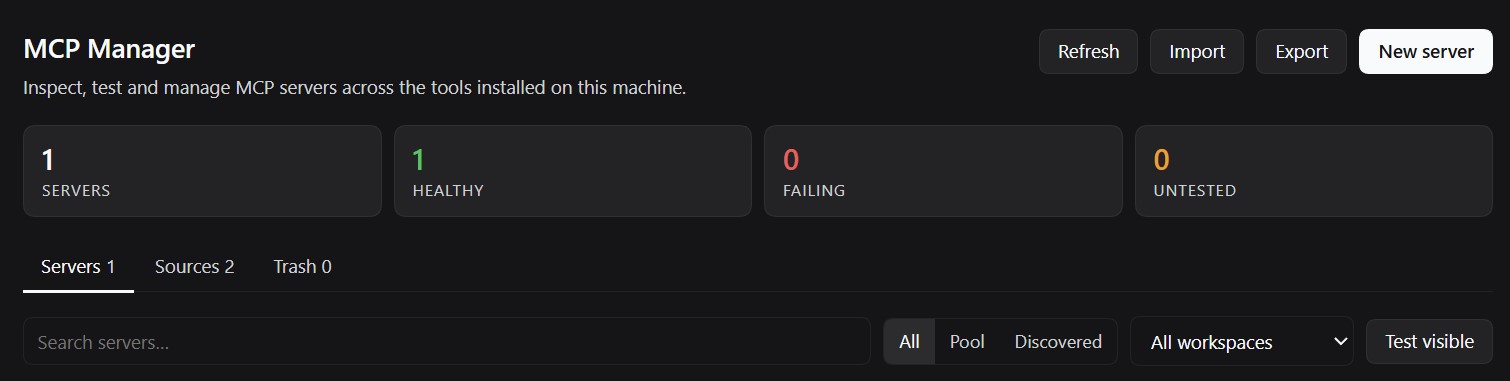
What it does
- Discovers MCP servers from the config files of DeepSeek Harness, Claude Desktop / Claude Code, Cursor, VS Code, Windsurf, Codex, Zed, Gemini CLI, OpenCode, Cline, Roo Code, Kilo Code, Qwen, Trae and more, both user-level and per workspace.
- Tests any of them for real: it performs the MCP
initializehandshake and lists the tools the server exposes, over stdio, streamable HTTP or legacy SSE. Failures come with a plain-English hint (missing executable, 401, DNS, certificate, timeout, unsupported protocol version). - Manages its own pool: create, edit, enable/disable, soft-delete to trash, restore and export servers.
- Exposes tools to the agent, per chat:
/mcp-<server>turns the bridge on for one conversation and every tool that server publishes is registered there asmcp_<server>_<tool>, callable directly — no separate MCP connector plugin needed. A chat's own choice always beats the pool-wide switch in Settings → MCP Manager, so a server can be on everywhere and off in one chat (or the other way round). Sessions reopen automatically when the server changes and follownotifications/tools/list_changed. - Stays visible even without tools: an exposed server that publishes nothing gets an
mcp_<server>_statusplaceholder tool, and a prompt-context line tells the model the MCP is connected but has no tools right now, so a disconnected host app is never mistaken for a missing server. - Exports the pool as
mcpServersJSON, VS CodeserversJSON or Codexconfig.toml. - Imports an existing config document by pasting it.
- Never rewrites other applications' files. Discovered entries are strictly read-only; the pool lives in the plugin's own state file.
It also registers six agent tools so the model can inspect and maintain the same inventory:
mcp_inventory, mcp_probe, mcp_save_server, mcp_expose_server, mcp_export_config, mcp_remove_server.
Chat command
Exposure is per chat. Every pool server gets its own /mcp-<server> command, so the composer's
command palette completes the name for you, and the first run exposes that server in the chat where you
typed it:
/mcp-<server>           toggle that server in this chat, e.g. /mcp-unity-mcp
                        first run: expose its tools here · next run: hide them here
/mcp stays available for the finer-grained verbs when you want them:
/mcp                    what is in the pool and what this chat can call right now
/mcp list               every pool server, its transport and its state here
/mcp on <name>          expose a server in this chat
/mcp <name>             shorthand for toggling it here
/mcp off <name>         hide it here again
/mcp tools <name>       the tool names currently published
/mcp refresh <name>     re-read the server's tool list (use after starting the app behind it)
/mcp test <name>        run the MCP handshake and report latency and tools
Local always wins: a choice made in a chat — either direction — beats the pool-wide switch in Settings → MCP Manager, and only affects that chat. Toggling a server on the settings page changes the default for every chat that has not made its own choice. Hiding a pool-wide server in one chat leaves it available everywhere else.
Some servers — Unity's relay is the usual example — only publish tools while their host application is
connected. While such a server is exposed and reports zero tools, the bridge re-reads its list every
15 seconds, so the tools appear on their own once the app connects; /mcp refresh <name> forces that read
immediately. Until tools show up the server is still visible to the agent: the bridge registers one
mcp_<server>_status placeholder tool for it (calling it re-reads the list and explains what to do) and a
prompt-context line names the server, its transport and its current state, so the model knows the MCP is
connected but has no tools instead of assuming it is missing.
The outcome renders in the conversation and never enters the model's context. Aliases: ls, enable,
disable, probe, reload. Only the plugin's own pool can be exposed — discovered servers stay read-only until you
copy them into the pool.
Where it shows up
Two entry points, both disabled independently if their slot is unavailable:
- Settings → MCP Manager – a page in the settings dialog, next to the built-in sections (order 26).
- Sidebar panel – a server-bars icon in the sidebar (order 3) that opens the same page in the central column. Pick it like any other panel; select another entry to leave.
The client half is a single plain-JS module (lib/client.js), so after changing it only a window reload is
needed — no rebuild step.
Install
Published as @zarpyk/dsh-mcp-manager. From the profile that should load it:
dsh plugin --profile <profile> add @zarpyk/dsh-mcp-manager
or, from a checkout of this repository:
plugin_manager install_bundle # target: this package directory
Using the Harness UI: Settings → Plugins → install from npm or from a local package directory.
Requirements: Node.js 20+ (the stdio probe spawns node-based servers) and a Harness build that provides
@deepseek-ai/dsh-client-ui-slots and @deepseek-ai/dsh-client-locale at >=0.2.0-rc.1 <0.3.0-0.
Configuration
The bundle patch is intentionally empty apart from the insert row:
- insert:
    - id: mcp-manager
      name: '@zarpyk/dsh-mcp-manager'
All behaviour is driven from the settings page; there is no required config.
Files and storage
- State (pool + trash + last probe results):
$DSH_HOME/mcp-manager/state.json(%USERPROFILE%\.dsh\mcp-manager\state.jsonon Windows by default). - The file is written atomically (temporary file + rename) and is only touched by explicit actions.
HTTP surface
The page talks to the host half over two routes, registered on the plugin's own connection:
| Method | Path | Purpose |
|---|---|---|
GET / HEAD |
/api/dsh-mcp-manager/state?workspace= |
Snapshot: servers, sources, trash, stats |
POST |
/api/dsh-mcp-manager/action |
All mutations and probes |
Every POST must carry x-dsh-mcp-manager: 1, a JSON content type and a same-origin Origin header when one
is sent; anything else is rejected with 403 / 415.
Actions: refresh, probe, spec, save, set-enabled, set-expose, delete, restore, purge,
empty-trash, import, export.
Responses are { "ok": true, "data": … } or { "ok": false, "error": "…", "code": "…" }.
Security notes
- Secrets in discovered configs are masked (
••••••plus the last four characters) before they reach the browser, except through the explicitspecaction used to pre-fill the editor. - Cross-origin mutations are refused, and the custom header makes plain HTML form posts impossible.
- Probing a stdio server executes its configured command. That is the same trust model as running the server in its original client; only probe servers you would also run yourself.
Development
lib/sources.js     where MCP configs live, per client
lib/parse.js       JSON/TOML config parsing, normalisation, masking
lib/probe.js       real MCP client (stdio, streamable HTTP, legacy SSE)
lib/bridge.js      keeps exposed pool servers connected and registers their tools
lib/state.js       pool state file
lib/discovery.js   file scanning and normalisation
lib/index.js       host half: HTTP routes, actions, agent tools, the /mcp command
lib/client.js      web half: settings page (plain JS, no build step)
Tests use the Node test runner and need no dependencies:
node --test test/parse.test.js test/probe.test.js test/plugin.test.js test/client.test.js test/render.test.js test/bridge.test.js
test/render.test.js renders the settings page with a tiny React substitute and a fixture snapshot, so the
whole tree (rows, details, tabs, editor) is exercised without a browser. The probe tests spawn a fake stdio
server and start throwaway HTTP servers on 127.0.0.1; nothing touches your real config files (the plugin
tests point HOME and DSH_HOME at a temporary directory).
Limitations
- Tool exposure covers pool servers (the plugin's own store). Servers found in other clients' config files stay read-only: use Copy to pool first, then expose them.
- Exposure supports stdio and streamable HTTP servers. Legacy SSE endpoints can be probed but not exposed yet.
- Live tool refresh relies on
notifications/tools/list_changed, which only flows on stdio; HTTP servers are re-read when you run/mcp refresh <name>(or reopen the page). Servers that publish no tools are polled every 15 seconds while exposed. - Project-level configs are only scanned for registered workspaces (plus explicit ones passed by the UI).
- Per-chat overrides follow the chat session: a chat opened before the override was set picks it up when it
starts its next step, and the override stays in
state.jsonfor that session id. - TOML support covers the subsets MCP clients actually write (tables, arrays, inline tables, dotted keys), not the whole TOML 1.0 grammar.
License
MIT.