dsh-turbo
已验证dsh-turbo · v0.2.0 · MIT
Best-of-N sampling with an LLM-as-a-Verifier judge for DeepSeek Harness: sample N candidates per model call, score them with fine-grained logprob verification, and stream back the tournament winner.
安装
dsh plugin add dsh-turbo 用 dsh --profile default --dump-config 确认 layer 已生效 —— 参见安装指南。
源码
标签
作者
说明文档
dsh-turbo
Best-of-N sampling with an LLM-as-a-Verifier judge for DeepSeek Harness — as one ordinary model route.
Pick the deepseek-turbo provider in your model selector and every model call samples N candidates in parallel, scores them with fine-grained logprob verification, and hands your agent the tournament winner. Faithful implementation of LLM-as-a-Verifier (Stanford Scaling Intelligence Lab): sampling 5 candidates with DeepSeek and ranking them with the same model lifted Terminal-Bench accuracy from 79% to 88% in the paper — outperforming closed frontier models at a fraction of the cost.
Install
dsh plugin add dsh-turbo
That's it if you already use the official DeepSeek route: dsh-turbo reads the same DEEPSEEK_API_KEY credential (credentials service first, environment second). Otherwise:
export DEEPSEEK_API_KEY=sk-...
Restart dsh, open the model selector, choose DeepSeek Turbo → DeepSeek-V4-Flash-Vision-Exp (Turbo). Done — no other configuration exists between you and best-of-5.
Default models, in order:
| Model | Input | Notes |
|---|---|---|
deepseek-v4-flash-vision-exp |
text + images | default; DeepSeek's multimodal model |
deepseek-v4-flash |
text | |
deepseek-v4-pro |
text |
Images flow end to end: candidates receive them as real multimodal input, and the verifier sees the same pixels when judging.
How it works
Every conversation model call (auxiliary calls like compaction/session titles pass straight through):
- Sample — N=5 parallel generations against the DeepSeek API, spread over a temperature ladder.
- Verify — pairwise comparative prompts on a 20-point scale anchored on how likely the candidate actually solved the task, requested with
logprobs: true, top_logprobs: 20. The reward is the expectation over the score token's probability distribution, not the argmax — the paper's key signal (one logprob evaluation ≈ 16 discrete-judge votes) — normalized to [0, 1]. Scores decompose over three criteria (specification adherence / output match / error signals), each seeing the same standing ground-truth note, and can repeat K times. - Select — a Probabilistic Pivot Tournament: one ring pass over a random circuit (each candidate judged once as A and once as B, cancelling slot bias), top ring scorers become pivots, everyone else is compared against the pivots, and Bradley-Terry preferences aggregate into a mean preference per candidate. Sub-quadratic in N.
- Replay — the winner's stream chunks replay to the agent loop, which sees one ordinary model call. The winner's own token usage is reported (so context accounting stays correct); the extra spend of losing candidates and verifier calls is tracked separately.
Verifier prompts share a byte-identical prefix (system + note + task context) across every pair of a step, and the candidate-pair message is byte-identical across that pair's criterion calls, so DeepSeek prefix caching absorbs most of the verification input cost.
Fidelity to the reference implementation
The scoring and selection follow llm_verifier v0.2.0 (2026-08-14), including the details its own issue history produced: the score distribution is read at the last <score_A> occurrence (a model that quotes the output format mid-analysis must not shadow its verdict), whitespace-only tokens are skipped when locating the tag, a fused > prefix is stripped from score tokens, and an unreadable evaluation contributes a neutral 0.5 rather than dropping out and silently re-weighting the rest.
Two deliberate differences:
- Integers 1–20 instead of letters A–T. Upstream uses letters because a single letter is one token on every backend. Probing the live DeepSeek API, the score position offered 18/20 legal integer alternatives versus 5/20 legal letter alternatives — DeepSeek fuses the closing
>into the letter token, so most alternatives there are unusable. On this provider integers carry more of the distribution the method depends on. - A run where nothing scored is reported as degraded. Defaulting an unreadable evaluation to neutral is upstream's behaviour, but taken to its limit it hides a total verification outage behind a tie-broken pick.
/turboand the decision log reportusableEvaluations, and a run with none is marked degraded instead of presented as a ranking.
Example: one image in, a playable 3D game out
examples/vision-3d-game is the full end-to-end run
on a stock DSH install — a maze image pasted into the composer, and the agent
builds a first-person 3D dungeon crawler from what it saw, then converts it into
a Counter-Strike style FPS in a follow-up turn. Both games were written entirely
by the model; open them in a browser and play.
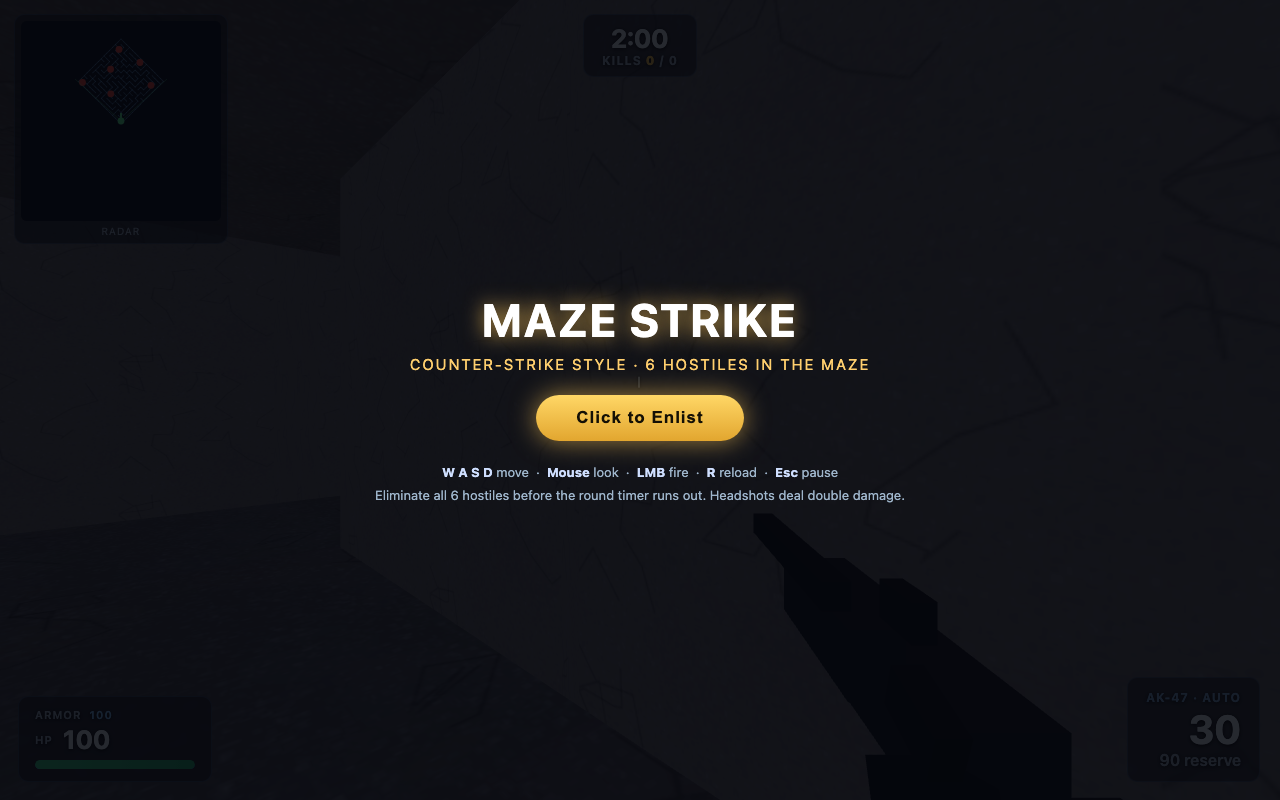
Across those two turns: 25 fan-out steps, 5 candidates each, zero degraded, 740 verifier calls, 19 M cached prompt tokens.
The /turbo command
/turbo— last decision (per-candidate mean preference, pivots, pair count, previews), how many evaluations fell back to neutral, and cumulative extra spend./turbo off//turbo on— temporarily pass single calls through without switching models.
Decision records also append to $DSH_HOME/dsh-turbo/decisions.jsonl for offline analysis.
Configuration (optional)
Everything lives in the dsh-turbo: section of $DSH_HOME/settings.yaml (hot-reloaded):
dsh-turbo:
  n: 5                  # candidates per call; 1 = plain passthrough
  repeats: 1            # K verifier repeats per pair and criterion
  pivots: 2             # ring leaders anchoring the comparison round
  criteria: coding      # coding | general
  temperatures: [0.2, 0.5, 0.8, 1.0, 1.2]
  verifierModel: deepseek-v4-flash-vision-exp   # default: the candidate model
  verifierTemperature: 1
  verifierMaxTokens: 2000
  apiKeyEnv: DEEPSEEK_API_KEY
  baseURL: https://api.deepseek.com   # any OpenAI-compatible endpoint that returns logprobs (vLLM!)
  decisionLog: true
Pointing baseURL at a vLLM (or any OpenAI-compatible, logprob-returning) server gives your self-hosted models the same best-of-N treatment.
Cost and latency
Best-of-N is a deliberate trade: with defaults, one step costs ~5 candidate generations plus ~36 short verifier calls (most of whose input is prefix-cache hits). Responses arrive after all candidates and verification complete — the status line shows sampling/verifying progress while you wait. Budget option: n: 3, pivots: 1 roughly halves the extra spend.
Notes
- A candidate that fails (transport error, empty response) is dropped; survivors still compete. If verification itself fails, the first surviving candidate is used and the decision is recorded — and reported — as degraded.
/turboand the status line appear only on surfaces that provide the commands / TUI status services; everything else works headless.
License
MIT