dsh-spreadjs-editor
已验证@grapecity-software/dsh-spreadjs-editor · v0.2.2 · MIT · Web 界面
DeepSeek Harness Web UI plugin: SpreadJS workbook editor for the harness's own right Sidebar, with binary save.
安装
dsh plugin add @grapecity-software/dsh-spreadjs-editor 用 dsh --profile default --dump-config 确认 layer 已生效 —— 参见安装指南。
源码
标签
作者
说明文档
SpreadJS Editor for DeepSeek Harness
GitHub · npm: @grapecity-software/dsh-spreadjs-editor
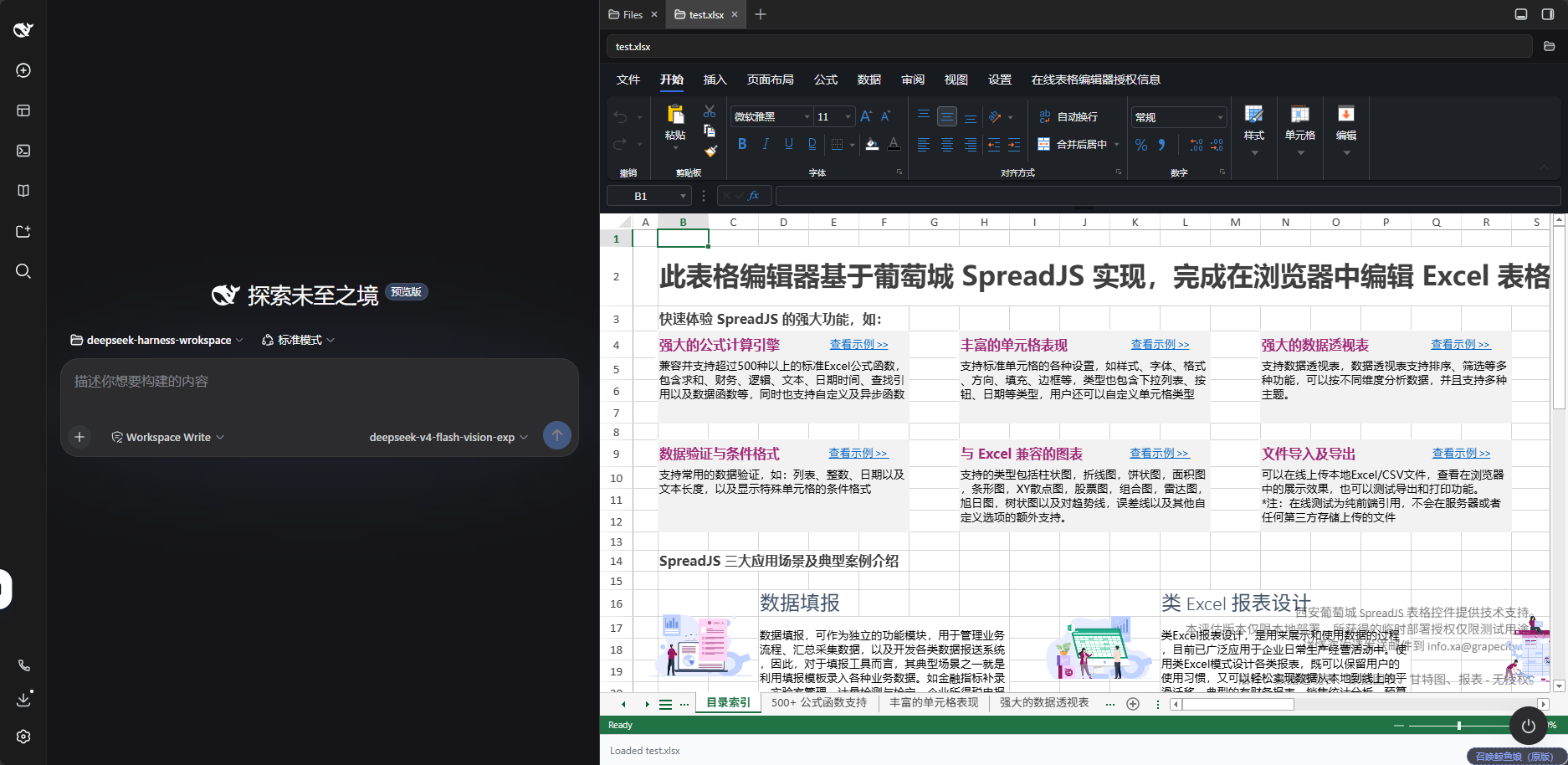
在 DeepSeek Harness Web UI 里,直接在右侧文件树中打开、查看和编辑 Excel / SpreadJS 文件。
A DeepSeek Harness Web UI plugin that opens, views, and edits Excel / SpreadJS files directly from the right-side file tree.
中文说明
功能
- 支持
.xlsx、.xlsm、.csv、.sjs、.ssjson文件。 - 从文件树打开工作簿,使用 SpreadJS Designer 编辑表格。
- 编辑后可直接保存回原文件:原子写入、限制在会话工作区内、带冲突检测。保存按钮在 DSH 文档头部自己的工具栏上,未保存时带一个标记点;它与「另存为…」的尺寸、字号、颜色都按 DSH 头部自身控件的规格绘制,而且只在表格文件上出现。
- 「另存为」可以把当前工作簿(含新建的空白工作簿)写进工作区的另一个路径,成功后就地切换到那个文件;同名文件不会被覆盖。
- 编辑器跟随 DSH 的浅色/深色主题,工具栏与工作表区域一起变;DSH 偏好设为「跟随系统」时自然跟着系统走。
- 「设置」标签里有「关于」按钮:内置版本、授权状态与版权信息在弹窗里。
配合 SpreadJS Driver 使用
本插件单独使用就是完整的:打开、编辑、保存工作簿都不需要别的插件。但配上 driver,它会多出一件单独做不到的事——让 AI 直接改你屏幕上这份表。
@grapecity-software/dsh-spreadjs-driver 是配套的 driver。它自己就能用,带着一整套文件级工具(新建 / 导入 / 状态 / 执行 / 导出 / 截图 / 草稿)和一个 spreadjs 编排 skill——但那些工具作用在工作区里的文件上,你只能看到结果,看不到过程。把这个编辑器装上并在设置里选中 driver,它就额外拿到一份活引用:改的是你正打开的那张表,改完当场就在你眼前。
安装
两个插件都装在同一个 web profile 下——driver 的活工作簿能力只存在于 Web UI 里:
dsh plugin --profile web add @grapecity-software/dsh-spreadjs-editor
dsh plugin --profile web add @grapecity-software/dsh-spreadjs-driver
dsh --profile web
装完重启 DSH,打开任意一个表格文件,然后在 设置 → SpreadJS 桥 里选中 SpreadJS Driver。(没装任何 driver 时这一页只有「不使用」一项,编辑器行为与本功能不存在时完全一样。)
「装了」不等于「激活」:两个包都必须出现在 profile 的
dsh.profile.bundles里。光pnpm add或dsh plugin add不一定替你写进去,装完请开一个真实会话确认工具确实在场。
两边是怎么配合的
编辑器持有你打开的那份工作簿,每个 driver 登记为候选人;名册里可以有多个(比如我们的测试夹具),但只有一个会拿到工作簿——就是你在设置里选中的那一个。
| 递出去的是活引用,不是副本 | 工作簿从不离开页面、也从不被序列化。所以通过它写的样式、公式、格式,当场就出现在表格里。 |
| 默认不落盘 | AI 的改动先活在工作簿里,你看着满意了它才会要求保存。保存走的还是文档头部那颗「保存」,因此冲突检测、工作区围栏、原子写入一条都不少。 |
| 名册只认被选中的那个 | 设置里改选别人、或选「不使用」,driver 的全部工具与 skill 都会让位。这个设置命名的是「谁来管这里的电子表格」,而不只是「谁暂时拿着这份活文档」。 |
| 编辑器始终是守门人 | 名册是候选人列表,不是广播。没有被递到工作簿的插件,没有任何办法去够到它。 |
装上之后,AI 会多出一件工具 sjs_live_execute(改你正打开的表)和一个 sjs_live_status(看看现在有没有活的设计器)。driver 其余的工具照旧作用于文件。
要求
- 本插件的「桥」名册随本版(0.2.2)一同发布。 更早的编辑器上装着 driver 不会报错,只是
sjs_live_execute永远找不到设计器——所以两个插件都建议用最新版。 - 两侧都需要 DSH
0.1.7-alpha.1或更新(设置命名空间从 Loader 记录 id 派生,是 0.1.7 才有的)。本插件自身在0.1.5-rc.3上仍可运行,见下面的版本表——但这一对不行。 - driver 自己还有前提:本机装了 Chrome 或 Edge(引擎跑在真实浏览器进程里),Node ≥ 22.19,导出含中日韩文字的 PDF 需要系统里有可嵌入的
.ttf字体。这些是 driver 的要求,细节见它的 README。
内置版本与文件兼容性
| 组件 | 内置版本 |
|---|---|
| SpreadJS | 19.2.0 |
| SpreadJS Designer | 19.2.0 |
内置版本、授权状态与版权信息在 Designer「设置」标签的「关于」弹窗里。低版本 SpreadJS 可能无法打开本版本保存的 .sjs 或 .ssjson 文件;与旧版系统交换文件时,建议保留原文件并确认兼容性。
安装
需要 DSH >=0.1.5-rc.3。插件使用 DSH 自带的右侧栏,不需要安装任何第三方侧边栏插件。
| DSH 版本 | 状态 | 说明 |
|---|---|---|
0.1.7-rc.2 |
✅ 构建与验收基线 | typecheck、201 项单测、两个 smoke、verify:package、probe:live 全部通过(probe:live 的版本核对需要先重启 DSH,见下文) |
0.1.6.x |
⚪ 未验证 | 没有核对过这个区间的平台:既未逐项跑验收,也不确定它是否已提供下表中的能力 |
0.1.5-rc.3 |
✅ 上一版验收基线 | 插件最初就是对着它构建并验收的;它会忽略「二进制后缀」声明,查看方式列表里仍可能出现纯文本一项;文档头部没有动作槽,因此保存入口只有 Ctrl+S,未保存状态靠面板右下角的浮动胶囊 |
0.1.7 起平台提供了三样本插件会用到的能力:文档定义里的二进制后缀声明(决定是否还提供纯文本查看方式)、内置的只读 Excel 预览(会与本插件并列出现在查看方式列表里),以及文档头部官方动作槽 sidebar.right.tab.document.actions(「保存 / 另存为」就注册在这里)。插件在 0.1.5-rc.3 上照常工作,只是拿不到这三点中的前两点,工具栏上的这两个按钮也不出现。
插件内置 SpreadJS 和 Designer,无需编译。使用已安装的 DSH CLI 安装并启动:
dsh plugin --profile web add @grapecity-software/dsh-spreadjs-editor
dsh --profile web
启动后,在 Web UI 右侧文件树中打开 .xlsx、.xlsm、.csv、.sjs 或 .ssjson 文件即可。
也可以通过 npx 安装并启动:
npx --yes @deepseek-ai/dsh@latest plugin --profile web add @grapecity-software/dsh-spreadjs-editor
npx --yes @deepseek-ai/dsh@latest --profile web
旧版本用户请参阅升级说明。
保存
保存的正式入口是 DSH 文档头部自己的工具栏(打开工作簿后,文件名旁边那颗「保存」)。它注册在 DSH 0.1.7 起的官方动作槽 sidebar.right.tab.document.actions 里,与其它查看器的控件排在一起;有未保存改动时,「保存」前会多一个标记点,像 Excel 标题栏的 *。改动写回你打开的那个文件,不会再问你"要不要保存",因为按下保存本身就是你的意图。
同一份写回也挂在 Ctrl+S 和 Designer 工具栏上的保存按钮上:插件把 Designer 的 Save 命令重定向到写回,所以这两处按下都不会再弹出下载框。(Designer 自带的「文件」标签页已从 Ribbon 上隐藏,见本节末尾。)
这两颗头部按钮并不引用 DSH 的按钮组件——第三方客户端插件不能假定内部的 @deepseek-ai/* 包在运行时一定可解析,解析失败会连编辑器一起挂掉——而是照抄了邻居的规格:28px 高、padding: 0 6px、12px 字号、常态 --dsw-alias-label-secondary,悬停转 --dsw-alias-label-primary 并给 --dsw-alias-interactive-bg-hover 底色,禁用转 --dsw-alias-label-tertiary 且不再响应。也就是头部「查看器名称」与图标按钮的那一套;有一条单测钉住这些数值,避免以后悄悄漂移。
它们只在本插件负责的文件上画出来。这个动作槽对每个预览文件都会渲染,所以按钮要在插件自己的编辑器占据屏幕时才出现——否则工作区里每个 Markdown、图片、日志旁边都会多两颗按不动的按钮。产品自己的「用本地应用打开」也是这个形状:没有可打开的应用时就什么都不画。
顺序上它们排在「用本地应用打开」之前。槽位是 list,条目按公开的 order 排序(先 priority,再 order,最后才轮到注册顺序),插件注册在 -10 —— 而这正是 DSH 自己给「头部动作里排第一」用的值(dsh-client-ui-agent-preset 注册会话头部标签时就是 order: -10)。这样「先保存、再考虑外部打开」是确定的阅读顺序,也不再受插件加载顺序影响;未保存的标记点也因此落在这一组的第一项上,一眼就能看到。
Designer 自带的「文件」标签页已经从 Ribbon 上隐藏:插件不再改写它的私有菜单模板(那段改写已删掉),也不让它留在那里——因为「文件」页里的保存是下载副本,与上面那颗写回的保存只隔一次点击,两颗都在就是误存副本的来源。现在这个编辑器里只有一处保存:文档头部的「保存 / 另存为…」,加上 Ctrl+S。
代价是「文件」页里的其它分类(新建、打开、导入、导出、打印、信息)也一并看不到了——这是隐藏整页的必然结果,如果你需要其中某一项,告诉我,我们把它单独接回 Ribbon。隐藏方式是按产品公开的命令名(CommandNames.FileMenuButton)加它模板画出的元素类名做一条 CSS,作用域限定在本插件的面板内;这条规则有单测钉住,创建编辑器时控制台也会回报命中的元素数与它实际算出的 display,所以将来产品改名、规则失效会被看见,而不是悄悄多出一颗下载按钮。
- 工作簿还没载入完时不让保存。 载入中的工作簿是空的,此时保存会用空表覆盖原文件;载入完成前保存命令会拒绝并说明。
- 不会冲掉别人的修改。 打开文件时插件记下其内容哈希;保存前重新比对,若磁盘上的文件在此期间被改过(Agent 改过、你在别处存过),保存会被拒绝并说明原因,而不是覆盖掉那些改动。
- 不会写出半个文件。 同目录临时文件写完后 rename 覆盖,其他程序任何时候读到的都是完整文件。
- 写不出工作区。 目标必须在当前会话的工作区内,越界(含
..逃逸)直接拒绝。 - 只有循环回环地址可用。 保存接口与 DSH 其它接口一样只服务本机来源;通过局域网地址访问时,需要把该地址加进
trustedHosts。
另存为
头部工具栏上的「另存为…」把当前工作簿写到工作区的另一个路径——包括在 Designer 里重新置空的空白工作簿。它不碰原来那个文件。
- 默认目标:同目录、同后缀,文件名后面加「副本」(
报表.xlsx→报表-副本.xlsx)。 - 成功后就地切换:这个标签页会直接开到刚写下的文件上继续编辑,不会另开一个标签页。
- 同名不覆盖:目标已存在时宿主会拒绝写入(写回要求带版本基线,另存为没有),对话框直接说「目标文件已存在,请换一个名字」,而不是默默覆盖。
- 只接受 5 种后缀:
.xlsx、.xlsm、.csv、.sjs、.ssjson。写出格式由后缀决定,其它后缀会写出打不开的文件,所以在提交前就拦下。 - 越界同样被拒:路径解析与围栏由宿主按写回那一套规则判定,工作区之外一律拒绝。
- 写不进去的另一种可能:正在载入或另一次保存尚未结束时,对话框会说「编辑器还没准备好」,不会假装成功。
未保存的改动
DSH 在标签页被切走时会卸载文档主体,平台也没有可供拦下的关闭钩子(关闭是同步的,文档定义里既无生命周期也没有否决点),所以这里不做「确认离开」的拦截,而是保证不丢:
- 切走再切回不丢。 有未保存改动的工作簿会在主体卸载前留成一份快照,切回同一个标签页时原样恢复,不需要重新读盘。
- 关掉标签页也不丢。 快照同时按文件路径保留;重新打开同一个文件时,只要磁盘上的文件仍是快照写下的那一版,就自动恢复,并在面板右下角的胶囊里说明来源。
- 文件被外部改过时不默默套用。 若磁盘上的文件已经变了(Agent 改过、你在别处存过),面板右下角会浮出一个胶囊提示「存在未保存的改动缓存,但文件已在磁盘上被修改」,由你选择恢复(用缓存继续,之后保存即写入磁盘)或丢弃(重新读盘)。
- 看得见,而且有两处。 头部工具栏的「保存」在有未保存改动时带一个标记点(像 Excel 标题栏的
*),这是 DSH0.1.7及以上才有的位置;面板右下角另有一个浮动胶囊:有未保存改动时显示「未保存的改动」并带一颗「丢弃」,保存成功后自己消失。它悬浮在表格上方、不占任何布局高度——这是它从「面板顶部常驻一行」改回来的原因——而0.1.5/0.1.6上文档头部还没有动作槽,这个胶囊就是唯一的状态提示,所以它必须留着。改动只会替换胶囊里的文字与按钮,且它只在有话说时出现。 - 整页关闭会提示。 刷新或关闭页面时,只要还有未保存的改动(含已留存的缓存),浏览器会弹出一次自己的离开确认。
- 保存即清空。 保存成功后,该文件的快照全部清除。
配置
如已获得许可证,在 web profile 的 cordis.patch.yml 中添加以下配置:
| Key | 默认值 | 说明 |
|---|---|---|
licenseKey |
'' |
SpreadJS 部署许可证。留空以带水印的试用模式运行。 |
designerLicenseKey |
'' |
独立的 SpreadJS Designer 部署许可证。留空保持 Designer 试用状态。 |
maxSaveBytes |
67108864 |
单次保存允许的最大字节数;超出直接拒绝,不做截断。 |
trustedHosts |
[] |
除本机回环地址外,额外允许调用保存接口的地址(局域网部署时使用)。 |
- id: spreadjs-editor
  config:
    licenseKey: 'YOUR_SPREADJS_KEY'
    designerLicenseKey: 'YOUR_DESIGNER_KEY'
修改后重启 DSH 并刷新网页。
还有一项不写在这里:bridge 是「SpreadJS 桥」设置页在 Web UI 里写的,代表用户选了哪一个桥。它同样属于本插件的配置,但不该手写进 patch——设置页会把写入结果如实报出来(写入被拒或失败时页面会说明),而手写的值不会经过这条检查。既没选过、又在 patch 里留空,含义相同:bridge: '' 等于「不使用」。本插件自身的设置页取代了 DSH 从这个 schema 自动生成的那一页,所以不会出现两个入口。
验证
| 命令 | 验证内容 |
|---|---|
npm run typecheck、npm test |
类型契约,以及 201 个单元测试(保存路由的每条守卫、文件地址解析与地址构造、另存为的目标校验、默认名与失败文案、保存命令重定向的每条分支、编辑器主题桥的每条分支、查看器名称与二进制后缀声明的边界、未保存改动的缓存规则与脏状态跟踪的边界、打开时「用文件还是用缓存」的每个分支、面板状态胶囊的状态与操作矩阵、文档头部动作的发布/订阅/命令路由、按钮的尺寸字号颜色规格、「只在表格文件上出现」的判定与注册顺序,隐藏 Designer「文件」Tab 那条规则的两处身份与作用域,以及桥选择的方向与「写入被拒也要报出来」、桥字段是否真的声明为 volatile、名册自身的契约(重复 id 拒绝、disposer 语义、只在真的变化时通知)、名册与设置页在有无 settings 服务时的接线,以及设置页每一行确实是照 DSH 自己设置页的行规格画的) |
node scripts/smoke-client.mjs |
构建后的浏览器半结构:loader 包装、内联的 SpreadJS 与样式、外部依赖只有 react |
node scripts/smoke-node.mjs |
构建后的宿主半:路由注册、许可证配置,以及保存路径的真实写盘、冲突与越界拒绝 |
npm run probe:live |
对着正在运行的 DSH 跑一遍真实保存:真实 ctx.fs 的解析、落盘、冲突守卫、工作区越界;并核对进程里装的是不是本构建(插件版本与内置 SpreadJS 版本) |
npm run probe:live 要求 DSH 已重启到本版本。宿主半会在 /spreadjs/api/health 回报插件版本与内置 SpreadJS 版本,探针据此判断「正在跑的进程是不是这一版」——回报的版本与本构建不一致会直接判失败;如果进程里是很早的宿主半(连版本字段都没有),探针会说明需要重启,如果连保存路由都报 404,则说明那更是旧版。可选参数:--url(默认 http://127.0.0.1:3080)、--session <id>、--home <DSH_HOME>。探针会在会话工作区内建一个临时文件,结束时删除。
许可
插件代码免费提供,采用 MIT 许可证。内置的 SpreadJS 和 Designer 是葡萄城商业产品,未配置许可证时可按其试用条款体验;插件免费不包含这两个产品的商业授权。
如用于正式部署或 SaaS 服务,请根据使用场景获取适用的 SpreadJS 和 Designer 授权。
English
Features
- Opens
.xlsx,.xlsm,.csv,.sjs, and.ssjsonfiles. - Open workbooks from the file tree and edit them with SpreadJS Designer.
- Save edits straight back to the file: atomic, confined to the session workspace, with conflict detection. Save lives in the harness's own document header, with a mark while anything is unsaved.
- Save As writes the workbook — including a new blank one — to another path in the workspace and moves the tab onto it; an existing name is never overwritten. Both header buttons follow the spec of the header's own controls (see Saving below) and appear on this plugin's own files only.
- Follows the harness's light or dark theme, toolbars and worksheet alike; a harness preference of
systemstill tracks the OS. - An About button in the settings tab reports the bundled versions, the licence state and the copyright.
Using it with the SpreadJS Driver
This plugin is complete on its own: opening, editing and saving workbooks needs nothing else. Paired with the driver, though, it gains the one thing it cannot do alone — letting the AI edit the very sheet you have on screen.
@grapecity-software/dsh-spreadjs-driver is that companion driver. It works by itself, carrying a full set of file-level tools (create / import / status / execute / export / screenshot / drafts) and a spreadjs orchestration skill — but those act on files in the workspace, so you see the result and not the work. Add this editor and select the driver in Settings, and it is additionally handed a live reference: it edits the workbook you have open, and the change lands in front of you as it happens.
Install
Both plugins go into the same web profile — the driver's live-workbook capability exists only in the Web UI:
dsh plugin --profile web add @grapecity-software/dsh-spreadjs-editor
dsh plugin --profile web add @grapecity-software/dsh-spreadjs-driver
dsh --profile web
Restart DSH, open any spreadsheet file, then pick SpreadJS Driver under Settings → SpreadJS bridge. (With no driver installed that page offers only "None", and the editor behaves exactly as it does without the feature.)
Installed is not the same as active: both packages have to appear in the profile's
dsh.profile.bundles.pnpm addordsh plugin adddoes not always write that for you, so after installing, open a real session and confirm the tools are actually there.
How the two fit together
The editor owns the workbook you open; each driver registers as a candidate. The roster may hold several — our test fixture, for one — but exactly one is handed the workbook: the one you selected in Settings.
| What is handed over is a live reference, not a copy | The workbook never leaves the page and is never serialized, so a style, formula or format written through it appears in the sheet at once. |
| Nothing reaches disk by default | An AI edit lives in the workbook until you are happy with it and the agent asks for a save. That save is the document header's own Save, so conflict detection, the workspace fence and the atomic write are all still in force. |
| The roster answers to the selection alone | Choose another bridge — or "None" — and every tool and skill the driver registers steps aside. The setting names the plugin that owns spreadsheets here, not merely the one holding the live document for the moment. |
| The editor stays the gatekeeper | The roster is a list of candidates, not a broadcast. A plugin that was not handed the workbook has no way to reach it. |
Installed, the AI gains sjs_live_execute (edit the sheet you have open) and sjs_live_status (is a designer live right now?). The driver's other tools go on acting on files.
Requirements
- This plugin's bridge roster ships with this version (0.2.2). On an earlier editor the driver installs without complaint and
sjs_live_executesimply never finds a designer — so use the latest of both. - Both sides need DSH
0.1.7-alpha.1or later (a settings namespace derived from the Loader entry is a 0.1.7 idea). This plugin still runs on0.1.5-rc.3by itself — see the version table below — but the pair does not. - The driver has requirements of its own: Chrome or Microsoft Edge on the machine (the engine runs in a real browser process), Node ≥ 22.19, and an embeddable
.ttfsystem font for PDF export containing CJK text. Those are the driver's terms; see its README.
Bundled Versions and File Compatibility
| Component | Bundled version |
|---|---|
| SpreadJS | 19.2.0 |
| SpreadJS Designer | 19.2.0 |
The About button in the Designer's settings tab shows the bundled versions, the licence state and the copyright. Older SpreadJS versions may not open .sjs or .ssjson files saved by this version. When exchanging files with older systems, keep the original files and check compatibility.
Installation
Requires DSH >=0.1.5-rc.3. The plugin uses the harness's own right Sidebar and needs no third-party sidebar plugin.
| DSH version | Status | Notes |
|---|---|---|
0.1.7-rc.2 |
✅ build and verification baseline | typecheck, 201 unit tests, both smokes, verify:package and probe:live all green (the probe's version check needs DSH restarted first, see below) |
0.1.6.x |
⚪ not verified | This range was never checked: neither point-by-point acceptance nor whether it already offers the capabilities below |
0.1.5-rc.3 |
✅ previous verification baseline | The release this plugin was originally built and accepted against; it ignores the binary-suffix declaration, so a plain-text entry may still appear among the viewer choices, and its document header has no actions slot — so Ctrl+S is the only Save entry and unsaved work shows in the panel's floating pill |
From 0.1.7 the platform offers three things this plugin uses: the binary-suffix declaration on a document definition (which is what removes the plain-text viewer choice), its own read-only Excel preview (which is listed beside this plugin), and the document header's actions slot sidebar.right.tab.document.actions, where Save and Save As are registered. The plugin still works on 0.1.5-rc.3; it simply does not get the first two, and the two header buttons do not appear.
The plugin includes SpreadJS and Designer, with no build step required. With the DSH CLI installed:
dsh plugin --profile web add @grapecity-software/dsh-spreadjs-editor
dsh --profile web
After startup, open .xlsx, .xlsm, .csv, .sjs, or .ssjson from the right-side file tree.
Alternatively, install and start through npx:
npx --yes @deepseek-ai/dsh@latest plugin --profile web add @grapecity-software/dsh-spreadjs-editor
npx --yes @deepseek-ai/dsh@latest --profile web
For upgrades, see the release notes.
Saving
Save's official entry point is the harness's own document header — the Save button beside the file name once a workbook is open. It is registered in the actions slot sidebar.right.tab.document.actions that DSH publishes from 0.1.7 on, next to the other viewers' own controls, and it carries a mark while anything is unsaved, like the * in Excel's title bar. It writes your changes back to the file you opened, and there is no second prompt, because pressing Save is the intent.
The same write-back is also on Ctrl+S and the Save button on the Designer's own toolbar: the plugin redirects the Designer's Save command, so neither of those reaches a download dialog any more. (The Designer's own File tab is hidden from the ribbon — see the end of this section.)
These two header buttons do not import the harness's button component — a third-party client plugin cannot assume an internal @deepseek-ai/* package resolves at runtime, and a failure there would take the whole editor down — so they copy the values from the controls beside them instead: 28px tall, padding: 0 6px, 12px text, --dsw-alias-label-secondary at rest, --dsw-alias-label-primary with the --dsw-alias-interactive-bg-hover background on hover, and --dsw-alias-label-tertiary with no response when disabled. That is exactly what the header's own viewer-name button and icon buttons do, and a unit test pins those values so they cannot drift unnoticed.
They are drawn only on the files this plugin handles. The slot renders for every previewed file, so the buttons appear only while this plugin's own editor is the body on screen — otherwise every markdown file, image and log in the workspace would carry two buttons that cannot do anything. The product's own open-in-app control works the same way: it draws nothing when there is no application to offer.
They are ordered before open-in-app. The slot is a list, and its entries sort by the documented order (priority first, then order, then registration sequence), where this plugin registers at -10 — the very value the harness itself uses for "first in a header actions list" (dsh-client-ui-agent-preset registers its session-header label at order: -10). That makes "save first, think about opening elsewhere second" a decided reading order rather than a side effect of plugin load order, and it puts the unsaved mark on the first item of the group, where the eye lands.
The Designer's own File tab is hidden from the ribbon. The plugin no longer rewrites its private menu template (that rewrite is gone), and it does not leave the tab in place either: the File tab's Save downloads a copy, one click away from the Save that writes the file back, and having both is how the wrong one gets pressed. This editor now has exactly one place to save — the document header's Save / Save As…, plus Ctrl+S.
The price is that the File tab's other categories (new, open, import, export, print, info) are not reachable from the UI any more; that is what hiding the page means. Say the word if you want one of them back on the ribbon and we will wire that one in. The hiding is one CSS rule keyed on the product's public command name (CommandNames.FileMenuButton) and the class its template draws, scoped to this plugin's panel; a unit test pins the rule, and creating the editor logs how many elements it matched and what display they compute to, so a rename in a future build shows up as a dead rule rather than as a quietly reappearing download button.
- A workbook that is still loading cannot be saved. It has no content yet, so saving would overwrite the file with an empty book; the save command refuses, with an explanation, until the load finishes.
- It will not clobber someone else's edit. The plugin records the file's content hash when it opens it and re-checks before writing; if the file changed in the meantime (an agent edited it, you saved it elsewhere), the save is refused with an explanation instead of overwriting those changes.
- It never leaves half a file. A same-directory temporary file is renamed over the target, so any other reader always sees a complete workbook.
- It cannot write outside the workspace. The target must sit inside the current session's workspace; anything else — including
..escapes — is refused. - Loopback only. The save endpoint serves the local machine like the rest of DSH. If you reach DSH through a LAN address, add that address to
trustedHosts.
Save As
另存为… in the same document header writes the workbook to a different path in the workspace — including a workbook that was reset to blank inside the Designer. The file it came from is left untouched.
- Suggested target: same directory, same suffix, with the localized word for a copy appended (
report.xlsx→report-copy.xlsx). - It switches this tab. On success the tab navigates to the file just written and keeps editing there; no second tab is opened.
- An existing name is never overwritten. The host refuses the write (a write-back needs a version baseline, and a Save As has none) and the dialog says so — "that file already exists; choose another name" — instead of replacing what is there.
- Only five suffixes are accepted:
.xlsx,.xlsm,.csv,.sjs,.ssjson. The written format follows the suffix, so anything else would produce a file this editor cannot reopen; it is refused before the write. - Containment is judged by the host, on the same rule as a write-back: a path outside the session workspace is refused.
- A busy editor says so. While a load or another save is running the dialog reports that the editor is not ready rather than pretending to have written.
Unsaved work
The harness unmounts a document body when its tab is hidden, and the platform offers no close hook to intercept (a close is synchronous, and a document definition has neither a lifecycle nor a veto point). So leaving is never blocked — and nothing is dropped either:
- Switching away and back keeps the edits. A dirty workbook is kept as a snapshot just before its body unmounts, and restored as-is when the same tab returns, without re-reading the file.
- Closing the tab keeps them too. The snapshot is also kept under the file's path, so reopening that file restores it — and says so in the pill at the panel's bottom-right — as long as the file on disk is still the version the snapshot was written from.
- A file changed elsewhere is never silently replaced. If the file on disk changed since the snapshot (an agent, another editor), the panel offers it instead in that same pill: Restore carries on from the buffer (a later save writes it to disk), Discard re-reads the file.
- It is visible, in two places. The header's Save carries a mark while edits are pending (like Excel's title-bar
*) — a position DSH0.1.7and later offer. The panel's own floating pill at the bottom-right showsUnsaved changeswith a Discard action while edits are pending, and disappears once everything is saved. It hovers over the sheet and costs no layout height — which is why it went back from a permanent row at the top of the panel to a pill — and on0.1.5/0.1.6, where the document header has no actions slot, it is the only state indicator there is. Editing only swaps the text and the buttons inside it, and it appears only when it has something to say. - Closing the page warns. A reload or close raises the browser's own prompt once, as long as anything is unsaved or still cached.
- Saving clears it. A successful save drops every snapshot for that file, so reopening starts from disk.
Configuration
If you have licenses, add the following to the web profile's cordis.patch.yml:
| Key | Default | Description |
|---|---|---|
licenseKey |
'' |
SpreadJS deployment key. Empty runs in evaluation mode with a watermark. |
designerLicenseKey |
'' |
Separate SpreadJS Designer deployment key. Empty keeps Designer in evaluation mode. |
maxSaveBytes |
67108864 |
Largest payload one save may carry; a bigger one is refused, never truncated. |
trustedHosts |
[] |
Extra authorities allowed to call the save endpoint, beyond loopback (for LAN deployments). |
- id: spreadjs-editor
  config:
    licenseKey: 'YOUR_SPREADJS_KEY'
    designerLicenseKey: 'YOUR_DESIGNER_KEY'
Restart DSH and refresh the browser after changing the configuration.
One more field is deliberately not in that table: bridge is written by the SpreadJS bridge page in the Web UI and records which bridge the user chose. It is this plugin's configuration all the same, but it should not be written into the patch by hand — the page reports honestly whether a write was accepted, and a hand-written value never goes through that check. Not having chosen yet and leaving it empty in the patch mean the same thing: bridge: '' is "None". This plugin's own page replaces the one DSH would otherwise synthesise from the schema, so there is only ever one entry point.
Verification
| Command | What it proves |
|---|---|
npm run typecheck, npm test |
The type contract, and 201 unit tests: every save guard, file-address parsing and address building, the Save As target rules, suggested name and failure wording, every branch of the Save-command redirect, every branch of the editor theme bridge, the viewer-name and binary-suffix edge cases, the unsaved-buffer and dirty-tracking rules, every branch of the file-versus-buffer decision at open, the panel state pill's state/action matrix, the document header actions' publication, subscription, command routing, button spec, "spreadsheets only" rule and registration order, both identities plus the scope of the rule that hides the Designer's File tab, the direction of the bridge choice and that a refused write is reported, that the bridge field really is declared volatile, and the registry's own contract (a duplicate id refused, disposer semantics, notifying only on a real change), the wiring of the roster and the settings page with and without a settings service, and that every row of that page is drawn to the harness's own settings-row spec |
node scripts/smoke-client.mjs |
The built browser half's structure: loader wrapper, inlined SpreadJS and styles, react as the only runtime external |
node scripts/smoke-node.mjs |
The built host half: route registration, license config, and the save path writing real bytes plus refusing conflicts and escapes |
npm run probe:live |
A real save against a running DSH: the actual ctx.fs resolving, writing, refusing a stale base hash, and refusing a workspace escape — plus a check that the process carries this build (plugin and bundled SpreadJS versions) |
npm run probe:live needs DSH restarted onto this version. The host half reports the plugin and bundled SpreadJS versions on /spreadjs/api/health, so the probe can tell whether the running process is this build: a version that disagrees with this build fails outright, a host half old enough to omit the field is reported as needing a restart, and a 404 means the host half predates the save route. Options: --url (default http://127.0.0.1:3080), --session <id>, --home <DSH_HOME>. The probe creates one temporary file inside the session workspace and deletes it.
License
The plugin code is free under the MIT license. Bundled SpreadJS and Designer are GrapeCity commercial products available for evaluation under their trial terms without license keys. The free plugin does not include commercial licenses for these products.
For production or SaaS deployments, obtain SpreadJS and Designer licenses appropriate to your use.