dsh-delete-turn
Đã xác minhdsh-delete-turn · v0.1.11 · MIT · Giao diện web
Per-message delete for DeepSeek Harness: remove a user message, one reply step, or a whole assistant reply from the derived model context through the official surface-replace contract, and hide it from the visible transcript without rewriting the append-o
Cài đặt
dsh plugin add dsh-delete-turn Xác nhận layer đã áp bằng dsh --profile default --dump-config — xem hướng dẫn cài plugin.
Mã nguồn
Thẻ
Readme
dsh-delete-turn
DeepSeek Harness 消息删除插件 —— 把一条消息从模型上下文里真正拿掉,同时从当前转录里隐藏它。 助手回复挂在官方 conversation.chat.assistant-actions 槽位;用户消息、注入上下文与工具调用卡由 DOM 增强补上入口。确认后经官方 surface-replace 契约追加替换事件:模型后续看到的历史里不再有这条内容,而原始会话日志一个字节都不改写。
中文

▲ 悬停消息行时出现的删除按钮(复制按钮右侧)
为什么需要它
DSH 的会话日志是 append-only 的:说错话、发错提示词、模型答偏了,这些内容会一直留在模型上下文里,污染后续每一轮。官方只提供了「压缩」(/compact)这种整段摘要机制,没有单条消息级别的删除。
这个插件把删除放回消息本身:
- 用户消息 → 删这一条;
- 思考卡 / 工具调用卡 → 删这一步(该步的
assistant/message与它请求的tool/result一起走,工具配对永不悬空); - 助手回复(官方操作条)→ 删这条回复连同它的思考、工具调用与注入上下文(你的提问保留);
- 用户消息行 → 还有第二个入口:删掉这一整轮(含提问、注入上下文与全部回复);
- 注入上下文行、失败回合行 → 同样有删除入口。
特性
- 模型上下文级删除 —— 追加一条官方
surfaceOp: { op: 'replace', startSeq, endSeq }替换事件,被遮蔽的内容不再进入deriveMessages();与宿主/compact同一套官方契约 - 整轮删除(新) —— 删掉一轮(含你的提问、注入上下文、全部回复与工具结果):一次普通的范围替换落地,后面的轮次原地保留、连编号都不变——不重放、不重编号、日志只多一条事件
- 转录级隐藏 —— 客户端按
data-chat-flow-*锚点与官方useChat快照定位行,删除后折叠退场;刷新、重启 DSH、换标签页后依旧隐藏 - 日志即台账 —— 隐藏依据直接从日志里的替换事件重建(替换事件的消息 source 标记为本插件),不依赖 localStorage、不需要预检,也不会和其它插件(如压缩)的替换混淆
- 原生视觉 —— 复用官方 primitives 的 Modal / Button 与主题 token,明暗主题自动适配;图标与全部文案为原创
- 中英双语 —— 弹窗、提示、错误原因随系统语言即时切换
- 安全边界 —— 只接受回环地址且 Host 为本机的请求;目标必须是当前 surface 节点、不能碰系统提示词头、回合进行中拒绝、已被删除的目标拒绝并给出机器原因码
截图
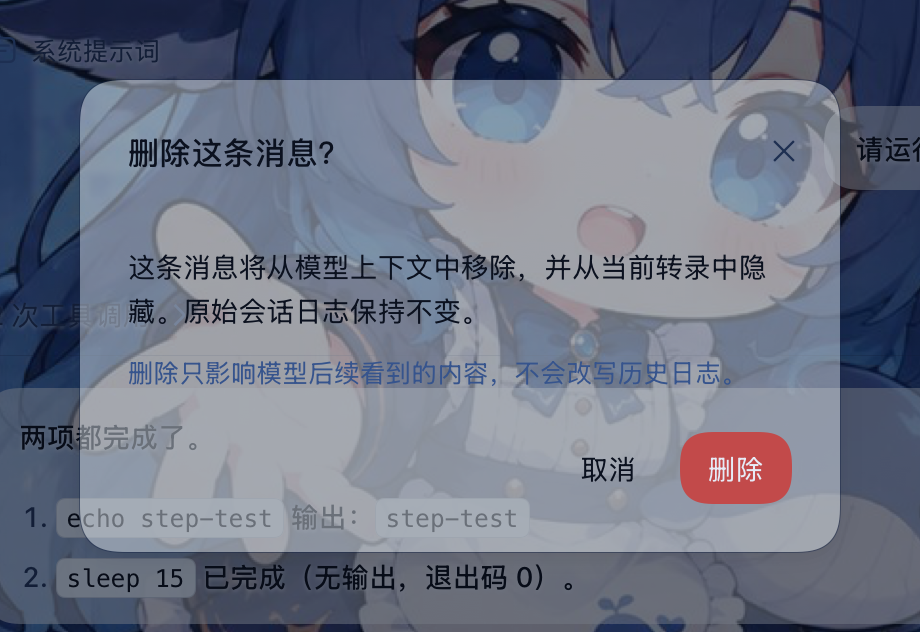
▲ 删除前确认:说明影响范围,原始日志不改写
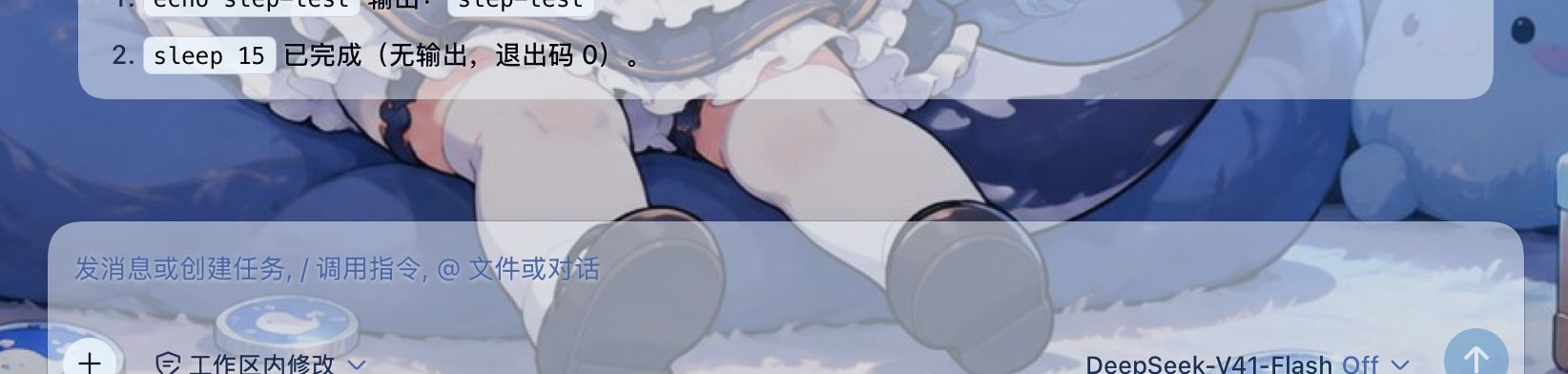
▲ 删除后:该行从转录中消失,后续内容自然上移
安装
# npm 安装(web profile)
dsh plugin --profile web add dsh-delete-turn

# 本地工作区(开发)
dsh plugin --profile web add link:/path/to/dsh-delete-turn
安装后需要完全重启 DSH 进程(宿主侧插件树只在启动时读取)。浏览器端 bundle 由宿主按请求动态 serve,重启后硬刷新页面即可生效。核实是否加载:
dsh --profile web --dump-config # 应出现 "# == dsh-delete-turn" 段落
使用
- 悬停任意消息行,点击行尾的垃圾桶按钮;助手回复的按钮在官方操作条(复制 / 分叉旁边)。
- 确认弹窗会说明这次删除的影响范围,点「删除」。用户消息行上还有一个「删除这一轮」入口:它删的是整轮(含你的提问、注入上下文与全部回复),后面的轮次原地保留、直接接上。
- 目标行折叠退场;模型上下文在下一轮请求重建时不再包含它。
工作原理
UI(官方槽按钮 / DOM 增强按钮)
  → 确认弹窗
  → POST /dsh-delete-turn/delete { sessionId, mode, seq? / messageId? / turn? }
宿主:
  sessionQuery.readSession() 读完整日志(live 优先)
  自实现 surface fold → 当前 surface 节点 + 历史替换遮蔽集
  校验(当前节点 / 区间干净 / 回合已闭合 / 不碰系统头)
  session.append('user/message', 短标记占位, {
    surfaceOp: { op: 'replace', startSeq, endSeq },
    sourceEventSeqs: [被遮蔽的全部 seq],
  })
  等待官方 session/flush 持久化检查点
  → 返回 { hidden: [{ seq, mode }] }
客户端:
  useChat 快照把 data-chat-flow-key 映射到节点,按 hidden 集合折叠行
  GET /dsh-delete-turn/state 在每次打开会话时重建 hidden 集合

整轮删除(mode: 'turn'):
  一次普通的 surface-replace:窗口 = 这一轮的全部表面节点
  (提问 + 注入上下文 + 每个 step 的 assistant/message 与 tool/result)
  落一条 turn-less 载体,后面的轮次原地保留、编号不变
  —— 不重放、不重编号、不碰代理循环,日志只多一条事件
设计要点:
- 为什么载体是 turn-less 的零宽空格 user 消息(绝不能开合成回合):删除的替换载体只能是不带回合的
user/message。开一个「合成 turn+step」来安放对模型隐身的空system/message会损坏日志:agent loop 只从它自己开的回合推进回合号,外部开掉的回合号会被它的下一个真实回合复用(冷读报turn/start does not open the expected turn),而任何按回合号做隐藏的客户端都会把被复用的那个真实回合整轮吞掉——此故障已在真实会话里复现(消息「被吞掉」)。因此载体退回 turn-less 形状,内容用单个零宽空格(空内容数组会被网关 400user message must have content,可读标记会被模型复述;零宽空格对校验器非空、对模型无字面文本)。代价:模型可能把这条载体读成一条空白 user 消息。历史日志里已经写入的簿记回合(旧版本产生)由客户端按/state的markerTurns隐藏。 - 为什么不读 React fiber / CSS 哈希类名:行定位只用官方
data-chat-flow-*锚点与官方useChat标准 hook,宿主 UI 重构不会静默失效。 - 为什么刷新后仍然隐藏:隐藏台账不是浏览器本地状态,而是日志里替换事件的可重放推导;宿主
/state路由在每次打开会话时重建它。 - 整轮删除不重放、不重编号:只遮蔽这一轮自己的表面节点,后面的轮次一条不动——日志的轮号、后续轮的内容、它们对其他事件的引用都不受影响,也不需要任何跨轮操作。
- 广告即承诺:
/state报出turnSeqs(现在哪些行可以整轮删除),它由路由规划用的同一个函数算出(turnableSeqs对每个候选调用planRange),所以界面上的入口不会变成一次注定被拒的点击。
已知限制
- append-only 语义下没有「反删除」:被遮蔽的内容无法真正恢复,删除不可撤销(原始日志仍在,可用官方工具自行重建会话)。
- 回合进行中不允许删除;请等回复结束后操作。
- 系统提示词头(surface 节点 0)不可删除。
- 助手操作条的删除范围是整条回复;要只删某一步,请用思考卡 / 工具卡上的按钮。
- 过程行(「已思考」「用时 N 秒」)不单独提供删除入口:它的范围同样是整条回复,与操作条重复,因此只保留操作条那一个。
- 已经被官方压缩(
/compact)移出模型上下文的内容不再显示删除入口:它已经不在上下文里,转录用意保留;入口只在内容仍可删时才出现。 - 整轮删除也删掉你的提问:它删的是整轮(提示词 + 注入上下文 + 全部回复步骤);只删回复请用助手操作条,只删提示词请用用户行上的垃圾桶。
- 这一轮的窗口里如果夹着别的插件留下的、既不是本插件占位符也不是静默载体的节点(例如某个可读的注入内容),整轮删除会直接拒绝(
range-not-clean),不会静默地把它一起删掉;含系统提示词头的第一轮不能整轮删除。 - 宿主侧插件树仅在 DSH 启动时加载:安装、更新插件后必须完全重启 DSH。
更新日志
0.1.11 —— 整轮删除改为单次范围替换(移除 mode: 'splice' 的重放实现)。三种原 mode 一个字节未改。
- 入口不变(用户消息行上第二个按钮,文案改为「删除这一轮」),删除只做一次普通的
replace:窗口 = 这一轮自己的全部表面节点,后面的轮次原地保留,不重放、不重编号、不碰代理循环。 - 「接上后面」过去靠重放后续轮次;现在后续轮本就不动,所以对话视图与模型上下文的结果一致,而日志更小、轮号不再被抬高。
- 移除
buildSpliceReplayWrites、planSplice、spliceableSeqs、syncLoopTurn与响应里的spliceId/replayTurns/sync;/state的spliceSeqs更名为turnSeqs(由turnableSeqs广告,逻辑不变:广告即承诺)。 - 兼容性不变:载体仍是
plugin:dsh-delete-turn+ 无可读内容,dsh-rerun-turn 仍把它认作「已退役的提问」。 - English: the whole-turn delete is now a single ordinary range replace (
mode: 'turn'): window = the turn's own surface nodes, one turn-less carrier, later turns untouched — no replay, no renumbering, no loop counter.buildSpliceReplayWrites/planSplice/spliceableSeqs/syncLoopTurnare gone;/stateadvertisesturnSeqs. Carrier interop with dsh-rerun-turn is unchanged.
0.1.9 —— 新动作:整轮删除并接上后面(mode: 'splice')。现有三种 mode 的行为一个字节未改。
- 新动作:用户消息行上多一个入口(路由新增
mode: 'splice'),一次写两类事件:① 一条 turn-less 的替换载体,遮蔽被删轮的第一个节点 → 当前面最后一个节点;② 把它之后的每一轮逐事件重放成新轮次(新轮号 = 日志的nextTurn、新消息 id、sourceEventSeqs重映射到副本、丢弃usage/内嵌 stream、工具调用只成对复制、TOOL_NOT_STARTED修复保持精确形状、系统消息与纯记账事件不复制)。重放实现与dsh-rerun-turn的buildReplayWrites等价(本仓库独立:是抄写,不是跨包 import),另加「丢掉只装系统消息的空步骤、保留步骤重新连续编号」。 - 循环计数器:重放写完的同一 tick 里把代理循环的空闲轮号计数器同步到日志的真实最大轮号(与
dsh-rerun-turn的syncLoopTurn等价)。不做这一步,循环的下一次提问会复用重放占用的号,日志随后冷读失败。 - 对话视图的验收:用平台自己的折叠算(
session.surface.nodes+deriveEventMessage)—— 折叠后是 A + 载体 + C′ + D′,载体是折叠里唯一多出来的空节点(客户端按hiddenVia隐藏它那一行),所以画出来就是 A、C′、D′。真实会话session-94db29c5(11 072 事件 / 180 轮)上实测:删除第 178 轮 → 原 179/180 的节点全部退场、重放成 181/182,session.surface.nodes437 → 436,节点的可见文本多重集只少了被删那一轮的 2 行(290 行逐一比对,无重复、无缺口)。 - 只用真实校验器验收:新增
test/contract.test.js(3 例,需要已安装的@deepseek-ai/dsh-session/-format-catalog,解析见tools/dsh-modules.mjs)与tools/verify-real-session.mjs(对真实会话跑一次,可重复)。两者都用平台的sessionFormatCatalog.createRestore严格冷读证明整份日志(含重放、以及之后循环自己开的新轮)仍然合法;两条负向控制:只遮蔽被删的那一轮 → 折叠后 C、D 各出现两次(校验器看不出来,由断言抓住);重放沿用原轮号 → 冷读拒绝turn/start does not open the expected turn。 - 广告即承诺:
/state新增spliceSeqs,客户端只在被广告的行上显示入口;真实会话上 62 条广告 100% 可规划。 - 测试:38 → 62 全绿(纯逻辑 11、宿主路由 4、真实校验器 3、客户端 DOM 6)。
- English: a new action,
mode: 'splice'— delete one whole turn (prompt included) and replay every later turn back as fresh events under new consecutive turn numbers. Two writes: one turn-less replacement carrier over the window "the deleted turn's first node → the last surface node", then event-by-event replays of the tail (fresh turn numbers from the log'snextTurn, fresh ids,sourceEventSeqsremapped onto the copies,usage/streams dropped, tool calls copied only as complete pairs,TOOL_NOT_STARTEDrepairs kept exact, system messages and log-only records skipped). The replay is a copy of dsh-rerun-turn'sbuildReplayWrites(the repos are independent), plus dropping steps that held nothing but a system message and renumbering the rest. In the same tick as the last write the agent loop's idle turn counter is re-pointed at the log's true last turn (syncLoopTurn, equivalent to the sibling's), without which the loop's next prompt would collide and the log would stop passing its cold read. Acceptance is measured on the platform's OWN fold (session.surface.nodes+deriveEventMessage): A + carrier + C′ + D′, where the carrier is the one extra node the fold adds and the client hides its row viahiddenVia— so the transcript draws A, C′, D′. Verified on a real session (session-94db29c5, 11 072 events / 180 turns): deleting turn 178 retires the old 179/180 nodes, replays them as 181/182, and movessession.surface.nodesfrom 437 to 436 while the visible-text multiset loses exactly the deleted turn's two rows (290 rows compared, no duplicate and no gap). The strict cold read (sessionFormatCatalog.createRestore) accepts the whole log plus the loop's next turn, and two negative controls are asserted: shadowing only the deleted turn duplicates C and D (the validator cannot see it — the assertion catches it), while a replay that reuses the original turn numbers is refused withturn/start does not open the expected turn./statenow advertisesspliceSeqs, computed by the same window check the route plans with, so the UI entry cannot become a doomed click (62 advertised rows on the real session, 0 unplannable). The three original modes are untouched; 38 → 62 tests.
0.1.7 —— 重新 apply 时清理自己的注入节点(互操作契约 I3)。只修 Bug,交互语义不变。
- 修复:插件被重新 apply(HMR / 插件开关 / bundle 组重载)时不再堆出幽灵按钮。每次 apply 都是新的模块实例、新的
WeakMap,而上一次 apply 注入的宿主还留在行里,于是同一条行上叠出多个删除按钮——真机 CDP 只读探针曾在同一行数到 3 个.dshdt-action-host。现在:①注入前先按命名空间属性[data-dshdt-action-host="1"]查一次已有宿主,找到就复用同一个节点(不 remove + re-insert),上一版留下、还没有属性的旧节点按.dshdt-action-host兜底认领并补上属性;②行内宿主与思考卡宿主分别用data-dshdt-action-host/data-dshdt-think-action认领,行不会把思考卡里的步骤按钮抢走;③ctx.effect的清理函数里按命名空间属性全局扫掉本插件注入的宿主(槽根节点也带上了命名空间标记),只删自己的节点,宿主的按钮与兄弟插件的节点一律不动。新增 4 条test/client.test.js用例覆盖「apply → dispose → 再 apply」与两个实例同时在场的时序。 - English: re-applying the bundle (HMR, plugin toggle, group reload) no longer stacks ghost buttons — every injected host carries
data-dshdt-action-host="1"(a reasoning host additionallydata-dshdt-think-action="1"), an injection adopts the host a previous apply left in the row instead of adding a second one, and thectx.effectteardown sweeps every node this plugin injected, matched by its own namespace, while host and sibling nodes are left alone. 4 newtest/client.test.jscases cover apply → dispose → apply.
0.1.6 —— 隐藏归因(互操作契约 I4)。只修 Bug,交互语义不变。
- 修复:兄弟插件隐藏的行,本插件不再替它显示出来。旧的「恢复可见」分支无条件把
row.style.display清成''——那一行若正被 dsh-edit-turn(data-dshet-hidden)或 dsh-rerun-turn(data-dsrr-hidden)按归属属性隐藏着,本插件一恢复就把别人的隐藏一并抹掉(行「复活」)。现在按契约 §4 在本地拷入foreignHideOn(row,'dshdt'):交还自己那份归属属性与折叠样式之前先确认没有别的归属属性,有则保持display:none,等对方自己解除;轮次导航标记同理,别人声明隐藏的回合不再留下跳转点。新增test/client.test.js(用 DOM stub 加载真实 client bundle,8 例)。 - English: rows another plugin is keeping hidden are no longer revealed by this plugin's restore pass — a local
foreignHideOn(row, 'dshdt')(contract §4) leavesdisplay:nonein force whiledata-dshet-hidden/data-dsrr-hiddenis present, so a sibling's hide survives until the sibling lifts it; the turn-navigation rail no longer keeps a jump mark for a turn another plugin declared hidden. Newtest/client.test.jsloads the real client bundle against a DOM stub (8 cases).
验证(怎么复现上面的结论)
cd dsh-delete-turn
npm test                                    # 62 例:纯逻辑 + 宿主路由 + 真实校验器契约 + 客户端 DOM
node tools/verify-real-session.mjs <session.v4.jsonl.zstd> [--turn N]
npm test里的test/contract.test.js与tools/verify-real-session.mjs需要已安装的@deepseek-ai/dsh-session/@deepseek-ai/dsh-session-format-catalog(插件本身不 import 它们)。解析顺序见tools/dsh-modules.mjs:DSH_SESSION_DIR→ 本仓库 / 父目录 / 兄弟仓库的node_modules→~/.npm/_npx/*/node_modules(npx 安装的 DSH)→ 裸包名。解析不到时测试会明确失败(而不是静默跳过),因为那意味着契约没有被验证。tools/verify-real-session.mjs不会写它拿到的文件:它解码日志、跑一次严格冷读、用解出来的事件建一个真实Session,然后对这个会话驱动插件的真实 HTTP 路由,最后再跑一次严格冷读并打印折叠前后的节点序列。拿真实会话试之前先cp到/tmp(本仓库的验收就是这么做的)。
兼容性
- 实测 DSH
0.1.6-alpha.2、0.1.7-alpha.2与0.2.0-rc.1(web 与 desktop profile,Safari / WebKit 与 Chromium 内核均验证)。 - 会话格式 v3 与 v4 都支持:v4 迁移会把插件 source 展平为
plugin:dsh-delete-turn,隐藏台账会同时识别{ kind: 'plugin', plugin: ... }与{ kind: 'plugin:...' }两代形状。 - 宿主半区零运行时依赖,全部服务经 cordis ctx 解析;缺少
sessionQuery时回退到 live 会话快照。 - 不修改 DSH 官方源码,不写任何私有事件类型。
License
MIT
English
▲ The delete action appears when a message row is hovered
Why
A DSH session log is append-only: a wrong prompt or a bad answer stays in the model context and pollutes every later turn. The only official tool is whole-range compaction (/compact); there is no per-message delete.
This plugin puts deletion back on the message itself:
- user message → remove that one message;
- reasoning card / tool card → remove that step (the step's
assistant/messageand thetool/resultit requested leave together, so tool pairs never dangle); - assistant reply (official action strip) → remove the whole reply attempt with its reasoning, tool calls and injected context (your prompt stays);
- user message → a second entry: delete this whole turn (prompt, injected context and every reply step included);
- injected-context rows and failed-turn rows get an entry too.
Features
- Context-level delete — appends the official
surfaceOp: { op: 'replace', startSeq, endSeq }intent; shadowed content no longer reachesderiveMessages(). Same contract as/compact. - Turn delete (new) — remove one whole turn (your prompt included, plus its injected context and every reply step and tool result) as one ordinary range replace: the later turns stay exactly where they are, under their own numbers — no replay, no renumbering, one extra event.
- Transcript-level hide — rows are located through official
data-chat-flow-*anchors and the officialuseChatsnapshot, then collapse out. The hide survives a reload, a DSH restart and other tabs. - The log is the ledger — hidden seqs are re-derived from the replacement events themselves (their message source is marked with this plugin), so there is no localStorage sidecar, no preflight, and no confusion with compaction replacements.
- Native look — official primitives (Modal / Button) and theme tokens; icon and all copy are original.
- Bilingual — zh/en dictionaries follow the active locale.
- Safety boundary — loopback-only routes; targets must be current surface nodes, the system-prompt head is protected, a running turn is refused, and already-deleted targets fail with a machine code.
Screenshots
▲ Confirmation states the exact scope; the log is never rewritten
▲ After deletion the row is gone from the transcript
Install
# npm (web profile)
dsh plugin --profile web add dsh-delete-turn

# local workspace (development)
dsh plugin --profile web add link:/path/to/dsh-delete-turn
Then fully restart the DSH process (the host plugin tree is read at startup only). The browser bundle is served dynamically, so a hard refresh after the restart is enough. Verify:
dsh --profile web --dump-config # expect a "# == dsh-delete-turn" section
Usage
- Hover a message row and click the trash action at its end; the assistant action sits in the official action strip next to copy/branch.
- The dialog states the exact scope; click Delete. A user row also carries “Delete this turn and close the gap”, which removes the whole turn (prompt included) and replays the turns after it back into place.
- The row collapses away; the model context stops containing it when the next request is rebuilt.
How it works
UI (official slot action / DOM-enhanced action)
  → confirmation dialog
  → POST /dsh-delete-turn/delete { sessionId, mode, seq? / messageId? / turn? }
Host:
  sessionQuery.readSession() reads the complete log (live-preferred)
  local surface fold → current surface nodes + historical shadowed seqs
  validate (current node / clean window / closed turn / protected head)
  session.append('user/message', short marker placeholder, {
    surfaceOp: { op: 'replace', startSeq, endSeq },
    sourceEventSeqs: [every shadowed seq],
  })
  await the official session/flush durability checkpoint
  → { hidden: [{ seq, mode }] }
Browser:
  useChat snapshot maps data-chat-flow-key to nodes; hidden seqs collapse rows
  GET /dsh-delete-turn/state rebuilds the hidden set on every session open

Turn delete (mode: 'turn'):
  ONE ordinary surface replace over this turn's own surface nodes
  (prompt + injected context + every step's assistant/message and tool/result)
  landing one turn-less carrier; later turns keep their place and their numbers
  - no replay, no renumbering, no loop state touched, one extra event
Design notes:
- Why the carrier is a turn-less zero-width user message (never open a synthetic turn): the replacement carrier can only be a
user/messagewith no turn bracket. Opening a synthetic turn+step to host a model-invisible emptysystem/messagecorrupts the log: the agent loop advances its turn counter only from the turns it opens itself, so its next real turn reuses the number this plugin burned (turn/start does not open the expected turnon the next cold read), and any turn-number-keyed client hiding then swallows that reused real turn — reproduced in production as messages “being eaten”. The carrier therefore stays turn-less, with a single zero-width space: truly empty content is refused by the gateway with 400user message must have content, and a readable marker gets quoted back by the model; a zero-width space is non-empty for every validator and carries no literal text. The cost: the model may read it as one blank user message. Bookkeeping turns already written to historical logs (older versions) are hidden client-side viamarkerTurnsfrom/state. - Why no React fiber or CSS-module hashing: rows are addressed through official
data-chat-flow-*anchors and the officialuseChatstandard hook, so a host UI refactor cannot silently detach the actions. - Why a reload stays hidden: the ledger is not browser state; it is a replay of the replacement events in the log, rebuilt by the host
/stateroute. - A turn delete neither replays nor renumbers: it shadows this turn's own surface nodes and nothing else, so the log's numbering, every later turn's content and their references to other events are untouched — and no cross-turn operation is needed.
- Advertised = accepted:
/statepublishesturnSeqs(the rows that can be turn-deleted right now), computed by the SAME function the route plans with (turnableSeqstriesplanRangeon each candidate), so an entry can never become a click that is bound to fail.
Known limitations
- Append-only semantics offer no un-delete: shadowed content cannot truly be restored, and deletion is irreversible (the original log survives; official tooling can rebuild a session from it).
- A running turn cannot be deleted; wait for it to settle.
- The system-prompt head (surface node 0) is protected.
- The assistant action strip deletes the whole reply attempt; use the reasoning/tool card to remove a single step.
- The process/disclosure row (“Thinking”, “N s”) carries no entry of its own: its scope is the whole reply, which the action strip already covers, so the duplicate was removed.
- Content already removed from the model context by official compaction (
/compact) no longer offers a delete action: it is not in the context any more and the transcript keeps it on purpose. - A turn delete also removes YOUR prompt: it deletes the whole turn (prompt + injected context + every reply step). To remove only the reply use the assistant action strip; to remove only the prompt use the trash action on the user row.
- If the turn's window holds a node that is neither this plugin's placeholder nor a silent carrier (some readable injected content, say), the turn delete refuses outright (
range-not-clean) instead of silently retiring it; the first turn, which holds the system-prompt head, cannot be turn-deleted at all. - The host plugin tree loads at DSH startup only: fully restart DSH after installing or updating the plugin.
Verification (how to reproduce the claims above)
cd dsh-delete-turn
npm test                                    # 62 cases: pure logic + host route + real-validator contract + client DOM
node tools/verify-real-session.mjs <session.v4.jsonl.zstd> [--turn N]
test/contract.test.jsandtools/verify-real-session.mjsneed an installed@deepseek-ai/dsh-session/@deepseek-ai/dsh-session-format-catalog(the plugin itself never imports them). Lookup order lives intools/dsh-modules.mjs:DSH_SESSION_DIR→ the repo's / its parent's / the sibling repo'snode_modules→~/.npm/_npx/*/node_modules(an npx-installed DSH) → the bare specifier. When nothing resolves the test fails loudly instead of skipping, because that would mean the contract is unverified.tools/verify-real-session.mjsnever writes the file it is given: it decodes the log, runs one strict cold read, builds a realSessionfrom the decoded events, drives the plugin's actual HTTP route against it, then cold-reads the result again and prints the folded surface before and after.cpa real session to/tmpfirst, exactly as this repository's own acceptance run did.
Compatibility
- Verified against DSH
0.1.6-alpha.2,0.1.7-alpha.2and0.2.0-rc.1(web and desktop profiles; WebKit and Chromium engines). - Both session formats v3 and v4 are supported: the v4 migration flattens plugin sources to
plugin:dsh-delete-turn, and the hidden ledger recognizes both{ kind: 'plugin', plugin: ... }and{ kind: 'plugin:...' }shapes. - The host half has zero runtime dependencies and resolves every service through the cordis context; it falls back to the live session snapshot when
sessionQueryis absent. - No DSH source is modified and no private event type is written.
License
MIT